Aquarium Setup Guide
Freshwater aquarium glossary
Plain-English definitions for 39 aquarium terms, from ammonia and cycling to KH, turnover and water conditioner.
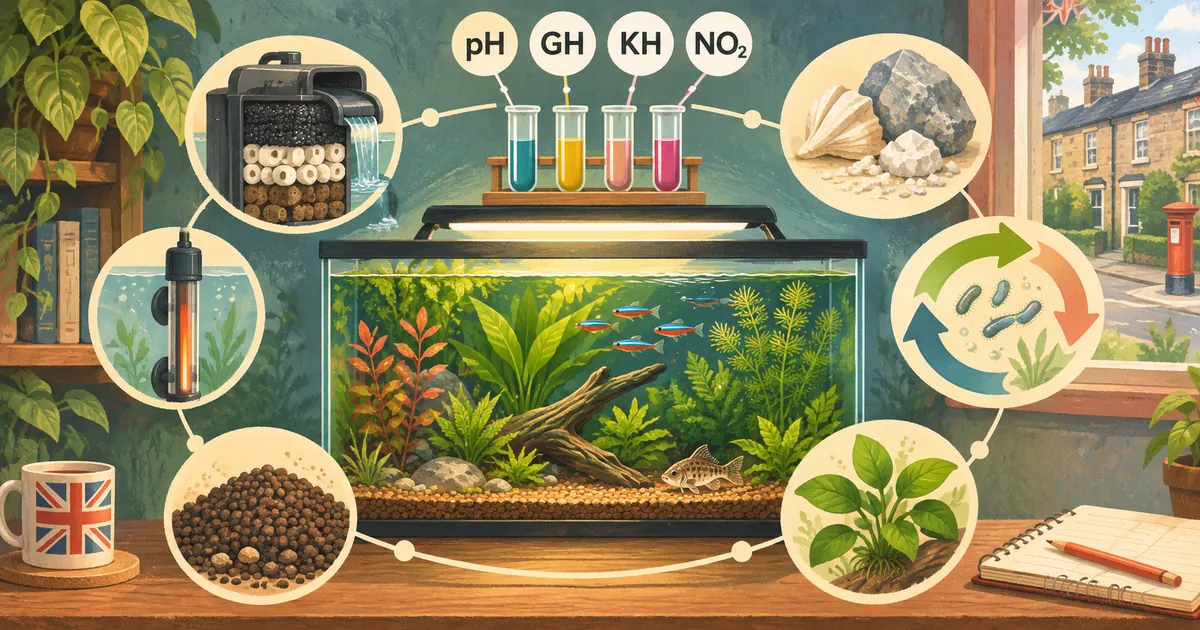
Use this A–Z alongside the beginner guides and knowledge base.
A
Ammonia
A toxic nitrogen waste measured during cycling and routine troubleshooting.
Air stone
A porous fitting that releases bubbles from an air pump and increases surface movement.
B
Beneficial bacteria
Informal term for the microbial community that processes ammonia and nitrite.
Biological filtration
Filter surfaces and flow that support waste-processing bacteria.
C
Canister filter
An external sealed filter connected to the aquarium by intake and return hoses.
Cycling
Maturing biological filtration so an ammonia input can be processed.
D
Dechlorinator
A water conditioner used as directed to neutralise disinfectants in tap water.
Drip loop
A low loop in a cable that helps stop water travelling towards a plug.
E
External filter
A filter body outside the aquarium, usually a canister.
F
Fishless cycle
Maturing a filter with a measured ammonia source before fish are added.
Flow rate
A maker-stated water movement figure, often in litres per hour.
G
GH
General hardness: mainly the concentration of dissolved calcium and magnesium salts.
Gross volume
The geometric tank volume before substrate, decor and air space reduce actual water.
H
Heater guard
A compatible cover intended to reduce contact with or damage to a heater.
I
Internal filter
A powered filter that sits within the aquarium.
J
Java fern
A commonly kept aquarium plant usually attached to hardscape rather than buried deeply.
K
KH
Carbonate hardness or alkalinity, related to buffering against pH change.
L
Litres per hour
A unit used for pump output or filter circulation; the two figures may differ.
M
Mechanical filtration
Physical capture of particles by foam, floss or similar media.
N
Nitrate
A later nitrogen-cycle product controlled through stocking, plants and water changes.
Nitrite
A toxic intermediate nitrogen compound that should be zero in a mature tank.
O
OATA
The Ornamental Aquatic Trade Association, which publishes UK care sheets.
P
pH
A logarithmic measure describing how acidic or alkaline water is.
Partial water change
Removing and replacing a proportion of aquarium water while fish remain in the tank.
Q
Quarantine
Keeping new or unwell fish in a separate suitable system for observation and care.
R
RCD
A residual current device intended to disconnect electricity under particular fault conditions.
S
Sponge filter
Usually an air-driven filter in which sponge provides mechanical and biological filtration.
Substrate
Sand, gravel or specialist material covering the aquarium base.
T
Thermostat
A control that switches a heater to maintain a set temperature.
Turnover
An informal comparison between circulation per hour and tank volume.
U
Understocking
Keeping fewer animals than a system’s possible limit; still subject to social group needs.
V
Volume
The amount of water, normally stated in litres; net water volume is lower than gross volume.
W
Water conditioner
A product used as directed to make tap water suitable for aquarium use.
X
X-ray tetra
A small shoaling species; its common name is not a general stocking recommendation.
Y
Yellow water
Discolouration that may come from tannins or waste and should be assessed with tests.
Z
Zebra danio
An active shoaling fish whose swimming space and group needs must be researched.