Guides · Cycling
How to fishless-cycle a freshwater aquarium
A welfare-first fishless cycling checklist using an aquarium ammonia source, repeated testing and patient stocking.
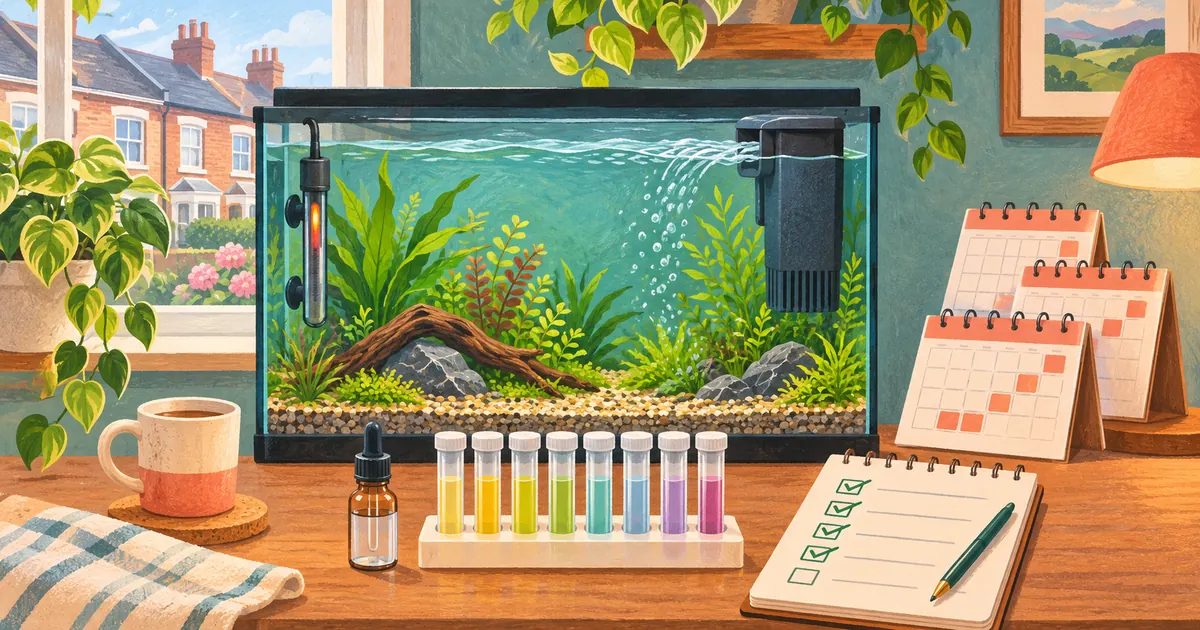
Fishless cycling grows the filter bacteria that process ammonia before animals are exposed to it. The process is controlled by test results, not by waiting a fixed number of days.
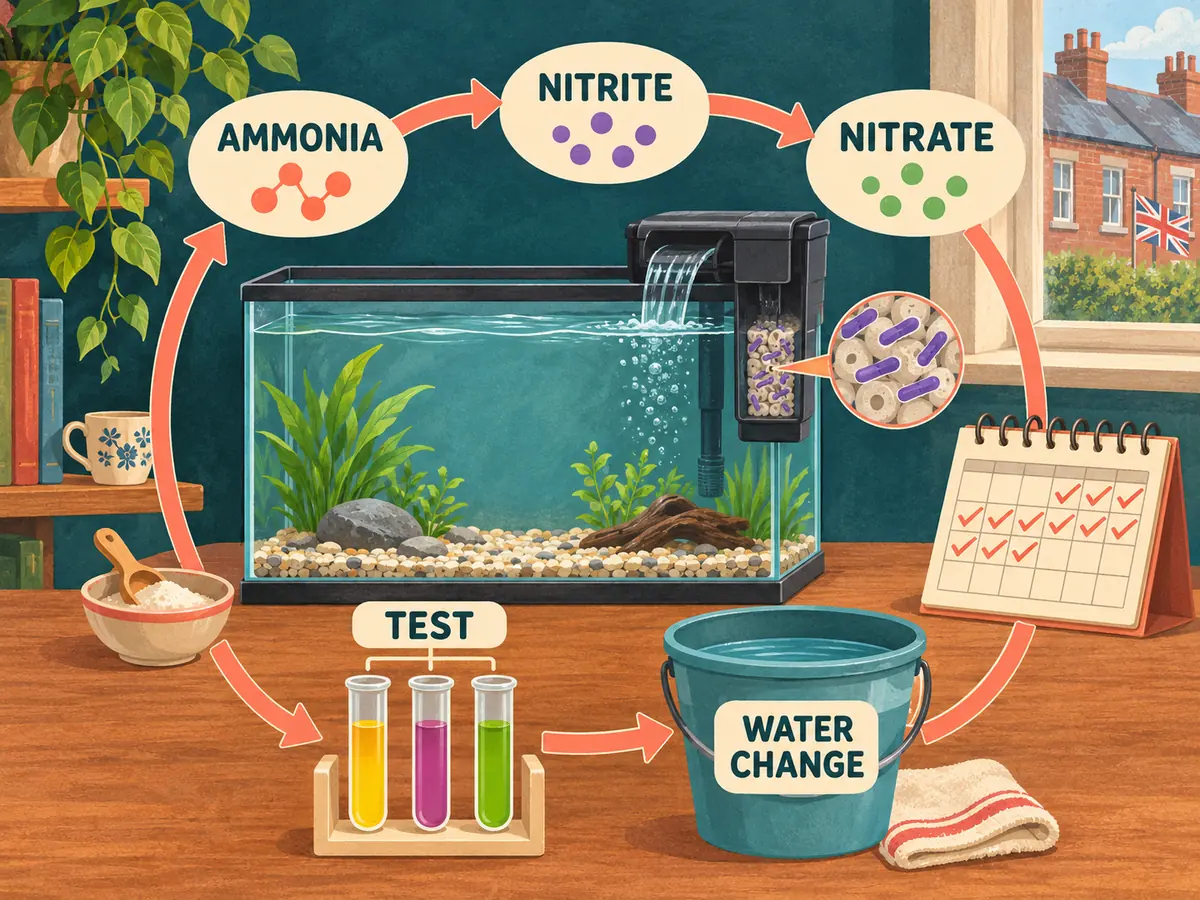
What is growing
Waste first becomes ammonia. One group of nitrifying bacteria processes ammonia to nitrite; another processes nitrite towards nitrate. In a new system those colonies are not yet sufficient. OATA describes filter maturation as growing these bacteria in the filter media and explains that ammonia and nitrite rise and fall while nitrate usually rises.
Use a measured aquarium product
Set up the tank, filter, heater if required, conditioner and circulation. Add an ammonia-based aquarium maturation product exactly as its instructions state. Household ammonia can contain surfactants or other additives and is not a safe guess. Keep a dated log of dose, ammonia, nitrite, nitrate, pH and temperature.
The timeline is a checklist
Early readings may show ammonia with little nitrite. Later, nitrite may rise. Continue the product instructions and testing until the system repeatedly processes the instructed ammonia input and both ammonia and nitrite return to zero. The RSPCA says there is no exact duration and describes at least two weeks; many setups take longer, so the calendar cannot certify readiness.
Before fish arrive
Make any final water change needed by the cycling-product instructions, condition replacement water and confirm stable temperature. Re-test. Add a modest first group suited to the water and tank, not the full planned stock. Every increase in feeding and livestock increases the load, so OATA advises adding fish slowly.
Seeding, settling and testing frequency
OATA suggests leaving a newly filled, dechlorinated aquarium for 24 to 48 hours so the temperature can settle and the equipment can be checked before maturation begins. It also notes that proprietary bacterial cultures, used as their makers instruct, can help to kick-start the filter. The RSPCA adds that disease-free filter media from a mature tank can be used to seed the filter, and advises testing every other day during cycling. It recommends adding fish only after a spike in ammonia and nitrite has returned to zero. It also points out that the waiting period gives you time to practise maintenance without putting any fish at risk.
Read the cycle as evidence
Cycling is not complete because water has been circulating for a week or because a bacterial product was added. It is complete only when the exact maturation method’s measured ammonia input is processed as instructed and ammonia and nitrite return to zero. Keep filtration and temperature stable throughout; switching equipment off between tests changes the conditions being assessed.
| Pattern in the log | Likely stage or question | Next check |
|---|---|---|
| Ammonia remains, nitrite absent | Early stage or inactive conditions | Product dose, temperature, pH and filter flow |
| Ammonia falls, nitrite rises | First conversion established | Continue the maker’s schedule and testing |
| Both fall, nitrate rises | Processing is developing | Confirm repeated performance, not one reading |
| Readings stall after water treatment | Possible chlorine exposure or unsuitable chemistry | Conditioner use, pH and product instructions |
| Both zero without a documented dose | No proof of capacity | Add only the instructed challenge dose |
Nitrate can support the interpretation but does not certify completion by itself: source water may already contain it, and plants may use some. Test conditioned tap water to establish a baseline.
A worked log structure
Use columns for date and time, maturation-product dose, ammonia, nitrite, nitrate, pH, temperature and notes. Suppose a dose is added on Monday according to the product label. Record the actual reading before that dose, then test at the intervals the instructions specify. If Thursday shows zero ammonia but measurable nitrite, record it and continue; do not add fish because half the pathway is working. Only the product’s completion rule decides when to perform a confirming challenge.
The RSPCA describes testing every other day during cycling and waiting for ammonia and nitrite spikes to return to zero. It also says there is no exact duration. OATA likewise explains that maturation time varies and stock should be introduced slowly.
Protect the bacteria you are growing
Always condition tap water before it reaches the filter. Keep media wet in oxygenated aquarium water during brief maintenance and do not replace it at the end of the cycle. Ensure the outlet moves the surface and the intake is unobstructed. If pH drops sharply, seek product-specific advice; nitrification can slow, and adding random pH chemicals may create a new instability.
Seeding can help only when the source is healthy. Mature media from an aquarium with unexplained illness can transfer pathogens. Bottled bacterial cultures are not interchangeable with the ammonia source: follow both labels and do not assume adding bacteria feeds them.
Moving from cycle to fish
Complete any final water change stated by the maturation method, using conditioned and temperature-matched water. Re-test, confirm equipment operation and add only a modest compatible first group. Feed carefully and test more often because the living waste pattern may differ from the challenge dose. Section 9 of the Animal Welfare Act 2006 makes a suitable environment part of the keeper’s duty in England and Wales; separate legislation applies elsewhere in the UK.
Cycling mistakes
- Adding an unmeasured quantity of household ammonia with unknown additives.
- Continuing to dose blindly when the chosen product says to wait or reduce.
- Changing all filter media immediately before the confirmation test.
- Treating bacterial cloudiness as proof that nitrifying capacity exists.
- Letting the heater or filter stop overnight during a test sequence.
- Buying fish for a predicted finish date before the results support it.
If fish have already been placed in an uncycled tank, this is no longer a fishless cycle. Test immediately and seek competent aquatic advice about conditioned water changes and feeding; do not continue a fishless ammonia-dosing schedule with animals present.