Guides · Water
Aquarium water testing: ammonia to hardness
Understand ammonia, nitrite, nitrate, pH, KH and GH, and turn results into a useful aquarium log.
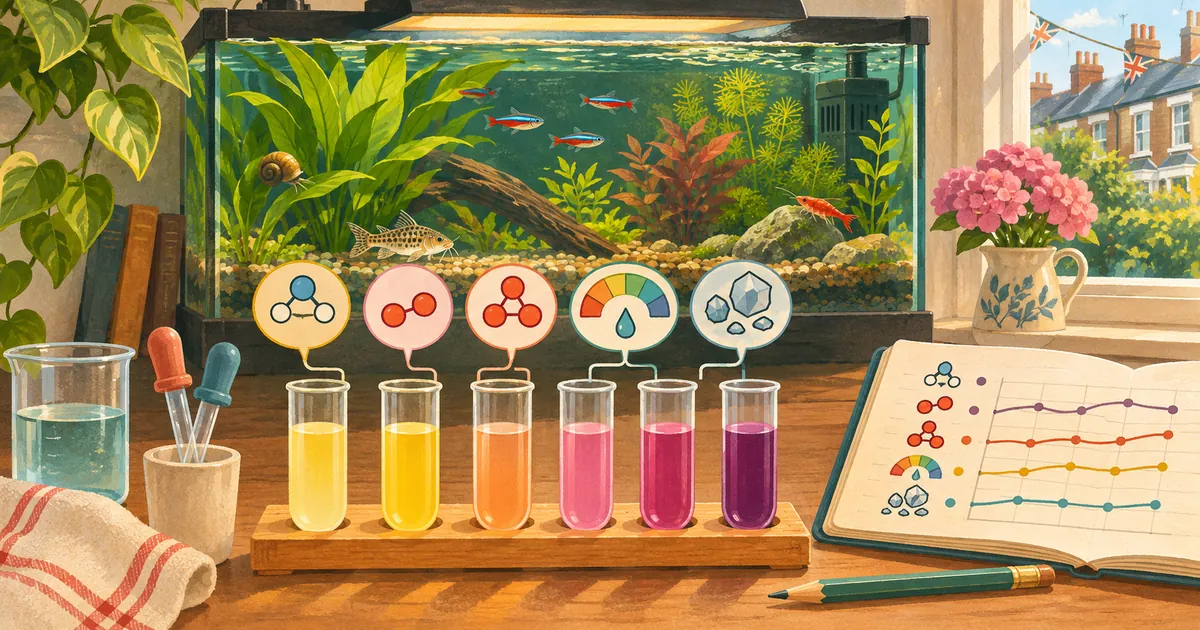
Clear water can contain invisible pollutants. Testing creates evidence: it shows whether the biological filter is working, whether maintenance is keeping pace and whether tap water suits the intended fish.
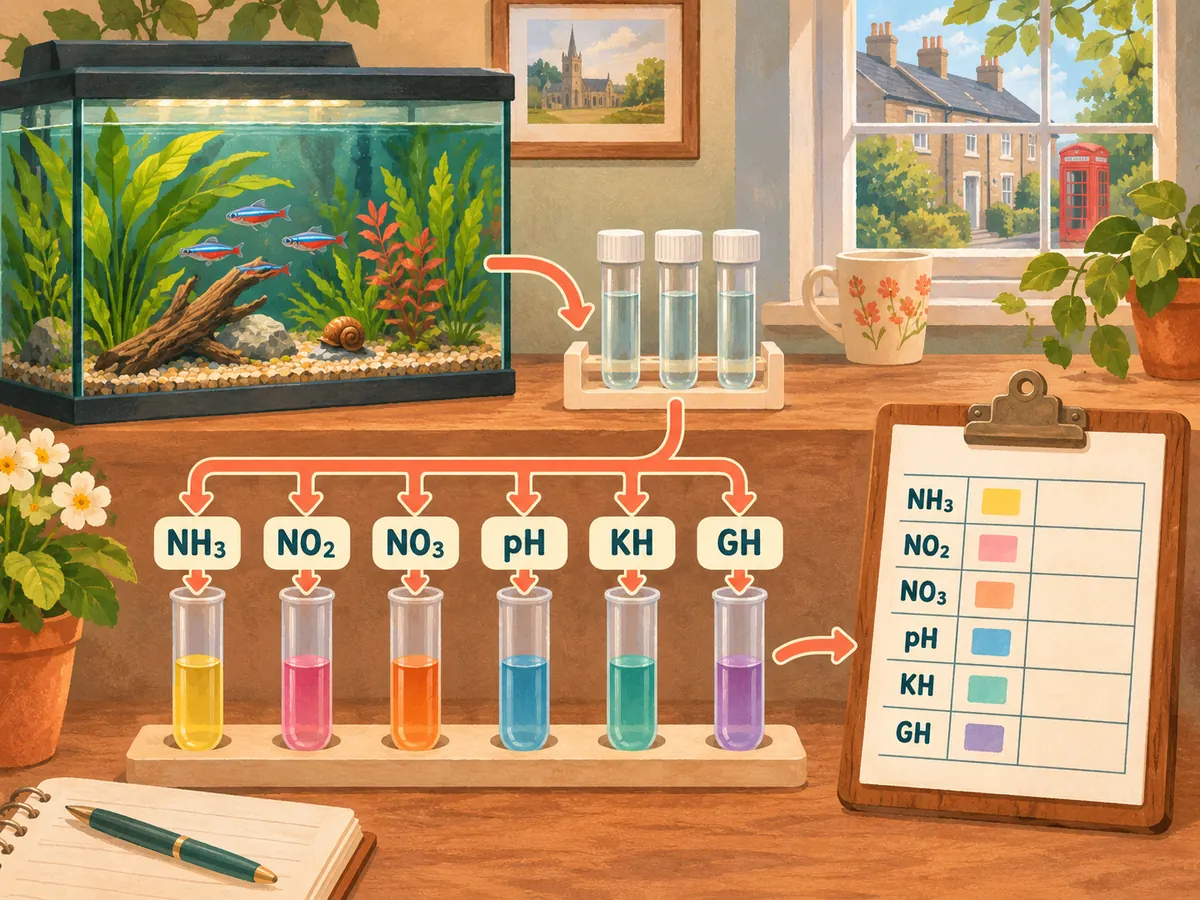
Ammonia and nitrite
Both should read zero in an established freshwater aquarium according to OATA and the RSPCA. Any detectable result deserves attention, especially with fish present. Check the kit scale and whether it reports a nitrogen form or the whole ion; never convert casually between instructions.
Nitrate
Nitrate is the later product of biological filtration and tends to accumulate. The appropriate ceiling depends on species and source water, so OATA directs keepers to species-specific care information. Compare tank nitrate with conditioned tap water and use regular partial changes rather than chasing a universal number.
pH, KH and GH
pH describes acidity or alkalinity. KH indicates carbonate buffering and influences pH stability. GH describes dissolved calcium and magnesium hardness. Stability within a suitable species range is generally more useful than repeatedly adding chemicals to force a fashionable value. Match livestock to local water where practical.
A useful log
Record date, time, kit, batch or expiry, temperature, ammonia, nitrite, nitrate, pH, KH and GH as relevant. Also note water changes, filter work, new animals, unusual feeding and medicines. Trends make a result more meaningful and give an aquatic specialist or vet better context.
How often to test
The RSPCA calls ammonia and nitrite kits essential rather than optional extras. It suggests testing an established aquarium once a fortnight and testing every other day while a new tank is cycling. OATA lists ammonia, nitrite, nitrate and pH as the tests needed for regular monitoring, and points out that nitrate in tap water varies widely between areas, so test your conditioned tap water as well as the tank. Test more often after adding fish, increasing feeding, cleaning the filter or seeing unusual behaviour. Reputable retailers may test a water sample in store, which is a useful cross-check if your own results look odd.
Make the test method reproducible
Read the instructions before wetting the tube: different reagents require different fill lines, drop counts, shaking times and waiting periods. Rinse the tube with aquarium water, take the sample away from a freshly dosed outlet, hold reagent bottles as directed and use a timer. Read the colour under neutral daylight against the supplied card. Never return a tested sample to the aquarium, and wash hands after handling reagents.
The two most common technique errors are poor mixing and reading too early or late. If a surprising result appears, repeat it with a clean tube. Check the expiry date and compare with a shop test or a second in-date kit before changing pH or hardness. API’s Freshwater Master Test Kit page lists separate ammonia, nitrite, nitrate, pH and high-range pH tests; the instructions for one bottle do not transfer to another.
Worked log: spotting a pattern
| Date and event | Ammonia | Nitrite | Nitrate | Interpretation |
|---|---|---|---|---|
| Before adding fish | 0 | 0 | record actual result | Baseline after fishless cycling |
| Day after first feeding | 0 | 0 | compare with baseline | No measured warning, continue observation |
| After filter stopped overnight | detectable | repeat test | record actual result | Treat as a filtration incident, not a cosmetic problem |
| After corrective water change | repeat | repeat | record actual result | Confirms whether dilution and restored flow helped |
This table deliberately gives no invented nitrate ceiling. Species tolerances and tap-water nitrate differ, while the urgent shared standard in the RSPCA guidance is zero ammonia and zero nitrite. Write the kit’s actual units beside every result; “one colour block” is not a transferable measurement.
Choosing which test answers the question
Use ammonia and nitrite to assess the biological filter, especially during cycling, after stocking, after a power failure or when fish behave unusually. Compare nitrate over time to judge whether feeding, stocking and partial changes are in balance. Use pH alongside KH because low buffering can help explain unstable pH. Measure GH when matching fish to local water or investigating moulting and mineral requirements in invertebrates; a pH result alone does not describe hardness.
NT Labs states that its multi-test includes ammonia, nitrite, nitrate, pH, KH and GH and explains that its nitrogen-compound results are expressed as nitrogen. Do not compare that number directly with a chart using a different chemical expression unless the maker supplies the conversion.
Result-led troubleshooting
- Ammonia detected with no recent stocking: check power, impeller movement, chlorine exposure and whether media dried out.
- Nitrite detected after adding fish: reduce feeding pressure, test frequently and use conditioned water changes while seeking competent advice.
- pH changes between morning and evening: repeat at consistent times and examine KH, aeration and plant activity.
- Tank nitrate differs little after a change: verify the volume changed and test the source water.
- Strip and liquid results disagree: confirm that both products measure the same parameter, units and range.
- Every result looks implausibly identical: inspect expiry, storage temperature, tube cleanliness and reagent technique.
Avoid adding a chain of correction products to force a preferred chart value. Sudden chemistry changes can harm fish even when the final number looks attractive. Match livestock to stable local water where practical, and change one controlled variable at a time so the next test remains interpretable.