Guides · Water
Best aquarium water test kits UK
Compare liquid aquarium test kits and strips for ammonia, nitrite, nitrate, pH, KH and GH, with a beginner testing routine.
This page contains Amazon affiliate links. As an Amazon Associate we earn from qualifying purchases.
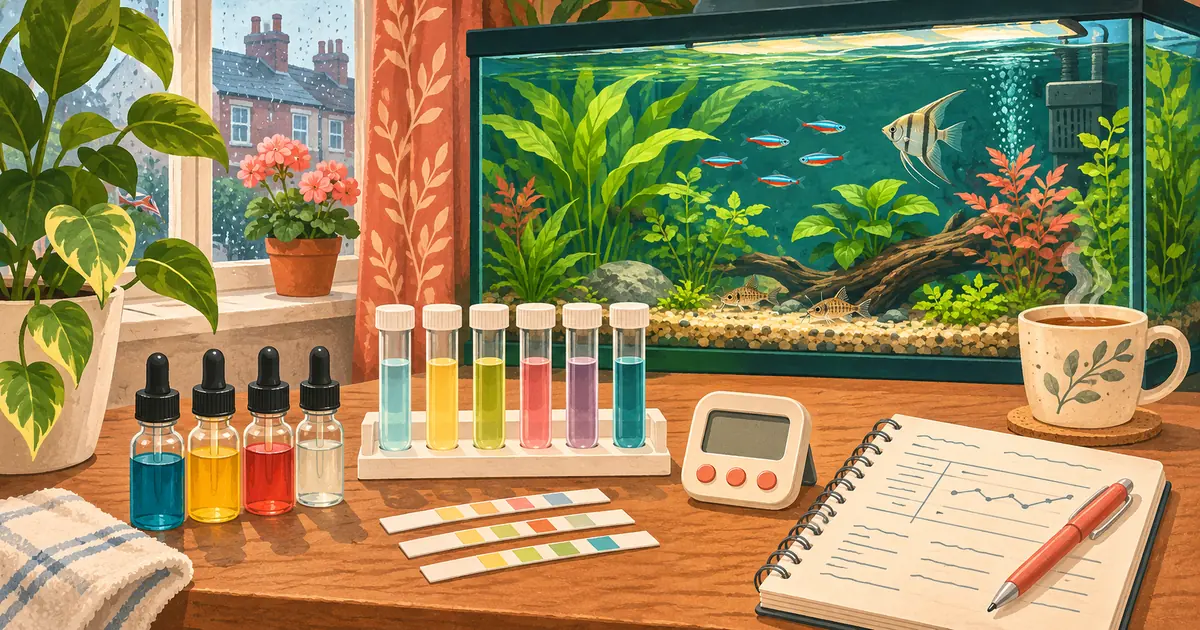
For a new freshwater aquarium, ammonia and nitrite are essential measurements. Nitrate and pH add context; KH and GH help match livestock to local water. Choose a kit you can read reliably and use exactly as its instructions specify.
We haven't tested these products. This comparison is based on makers' published specifications and manuals, retailer listings and owner reviews (checked 15 November 2026).
NT Labs Aquarium Lab Multi-Test
NT Labs says its liquid kit covers ammonia, nitrite, nitrate, pH, GH and KH, with up to 200 tests combined. The inclusion of both hardness tests makes it a broad single-box option for checking tap water as well as the cycling process. Note that its page explains results are expressed as nitrogen for the nitrogen compounds, so compare numbers using the supplied guide rather than mixing scales.
API Freshwater Master Test Kit
API’s UK page lists ammonia, nitrite, nitrate, pH and high-range pH. It does not list GH or KH, so those need separate tests if the chosen fish require hardness matching. API instructs users to follow the booklet for each test; timing, shaking and drop counts are part of the method.
Strips versus liquid reagents
For current availability, see the API Freshwater Master Test Kit, NT Labs Aquarium Lab Multi Test Kit, NT Labs Aquarium Lab Mini-Test Kit and Tetra Test 6-in-1 strips on Amazon UK. These listings represent liquid multi-test kits, a smaller liquid kit and strips; compare the named parameters and instructions rather than assuming every format measures ammonia.
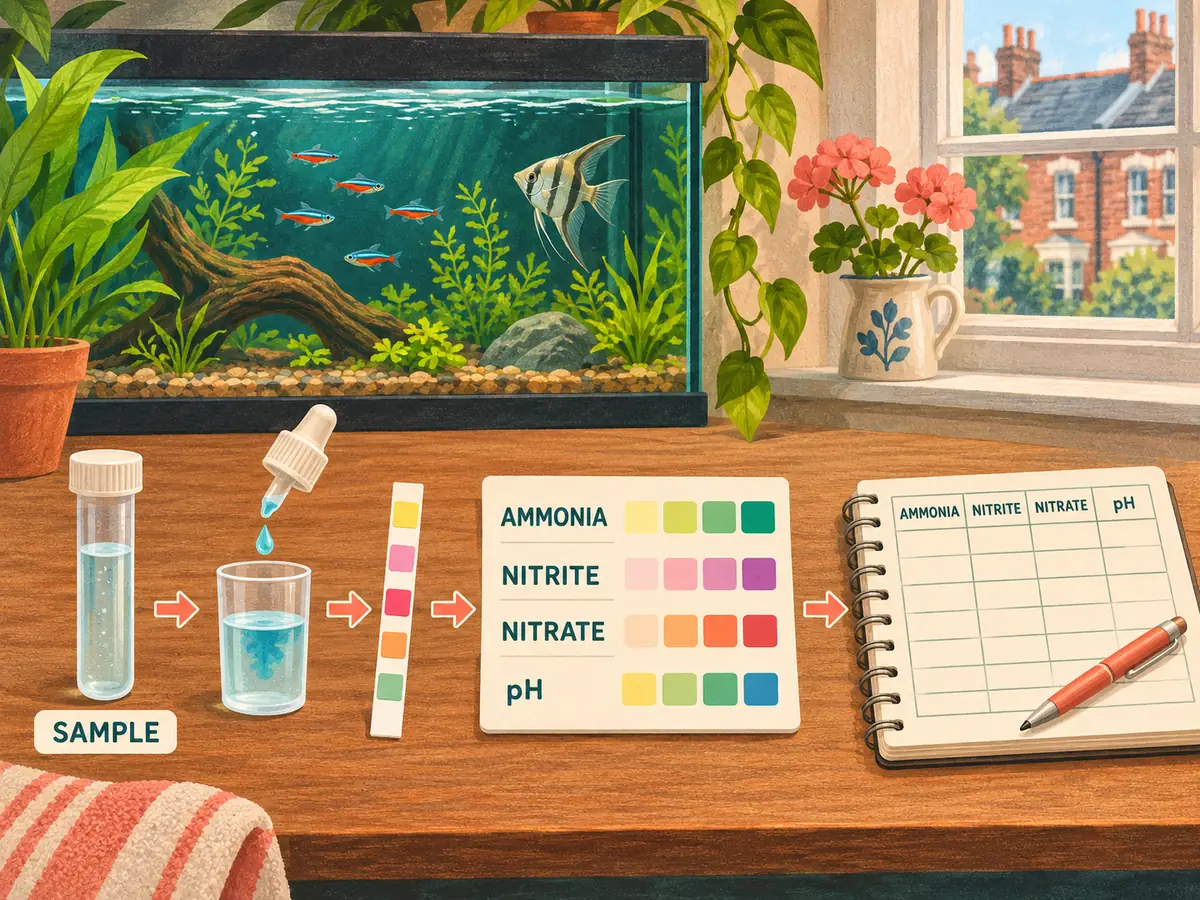
Strips are quick and can be useful for routine trends, but check whether the specific strip includes ammonia: many multi-strips do not. Liquid kits take longer and involve reagents, test tubes and colour comparison. Whichever format you choose, check expiry dates, store it as directed, use clean tubes and compare colours in neutral light.
What results mean
OATA and the RSPCA both state that ammonia and nitrite should be zero in an established freshwater aquarium. A single result is not a diagnosis. Record the date, temperature, maintenance and any livestock changes. If ammonia or nitrite is detected, protect welfare with prompt partial water changes using conditioned, temperature-matched water and seek competent aquatic advice.
Use a parameter matrix
Do not buy by the number of tests printed on the box. List the questions the aquarium must answer, then mark whether each candidate measures them directly.
| Parameter | Needed when | Buying check |
|---|---|---|
| Ammonia | Cycling, new stock, distress or filter trouble | Many multi-strips omit it |
| Nitrite | Cycling and biological-filter checks | Confirm the low end can show zero clearly |
| Nitrate | Tracking waste and water-change effect | Compare tank with source water |
| pH | Matching species and monitoring stability | Check the covered range |
| KH | Investigating buffering and pH movement | Often sold separately |
| GH | Matching fish and invertebrates to hardness | Not interchangeable with KH |
NT Labs lists all six in its Aquarium Lab Multi-Test. API lists ammonia, nitrite, nitrate, pH and high-range pH, so hardness requires another product when relevant. Neither configuration is universally best: buy the set that covers the planned species and local water.
Compare cost per useful result
A headline “up to” test count can combine parameters with different reagent consumption. Divide the price by the number of complete panels you will actually run, not by every individual colour reading. Include replacement tubes, separate GH/KH kits and expiry before a large bottle is used. A smaller kit used correctly is better value than broad chemistry that sits unread.
For example, a cycling panel may need ammonia and nitrite every other day, while GH changes slowly. Running the full six-parameter panel each time wastes hardness reagent; schedule each test according to the question.
Technique is part of accuracy
Use the exact fill line, bottle orientation, drop count, shaking and wait time. Read colours in neutral light and avoid comparing a wet strip after the maker’s time window. Rinse tubes with aquarium water before sampling, discard the tested water and keep reagents away from children and animals. If a result is unexpected, repeat it with clean equipment and an in-date kit before adding corrective chemicals.
The RSPCA identifies ammonia and nitrite kits as essential and recommends frequent testing during cycling. A retailer test can provide a cross-check, but take a clean labelled sample promptly and ask for numerical results and units rather than “fine”.
Which format suits which job?
Liquid drop kits offer individual reagents and broad parameter choice but depend on careful timing and colour comparison. Strips are quick for routine screening and travel, yet the exact strip may not include ammonia. Digital instruments can help with parameters such as temperature or pH, but require calibration, storage and suitable standards; a display is not automatically more reliable than fresh reagents.
Test-kit mistakes
- Assuming six-in-one means the same six parameters across brands.
- Mixing a cap, tube or colour card from another kit version.
- Reporting a colour name without the value and unit.
- Storing reagents in a hot aquarium cabinet despite label instructions.
- Using aquarium salt, conditioner or medication without checking test interference guidance.
- Chasing pH while ignoring KH and the stability of the source water.
Choose a kit you can read consistently, then keep a dated log with batch or expiry information. Trends taken by the same careful method are usually more informative than isolated numbers from several formats.