Guides · Equipment
Best aquarium filters UK: choose by tank and livestock
Compare internal, sponge, hang-on and external aquarium filters by real circulation, media access, flow control and maintenance.
This page contains Amazon affiliate links. As an Amazon Associate we earn from qualifying purchases.
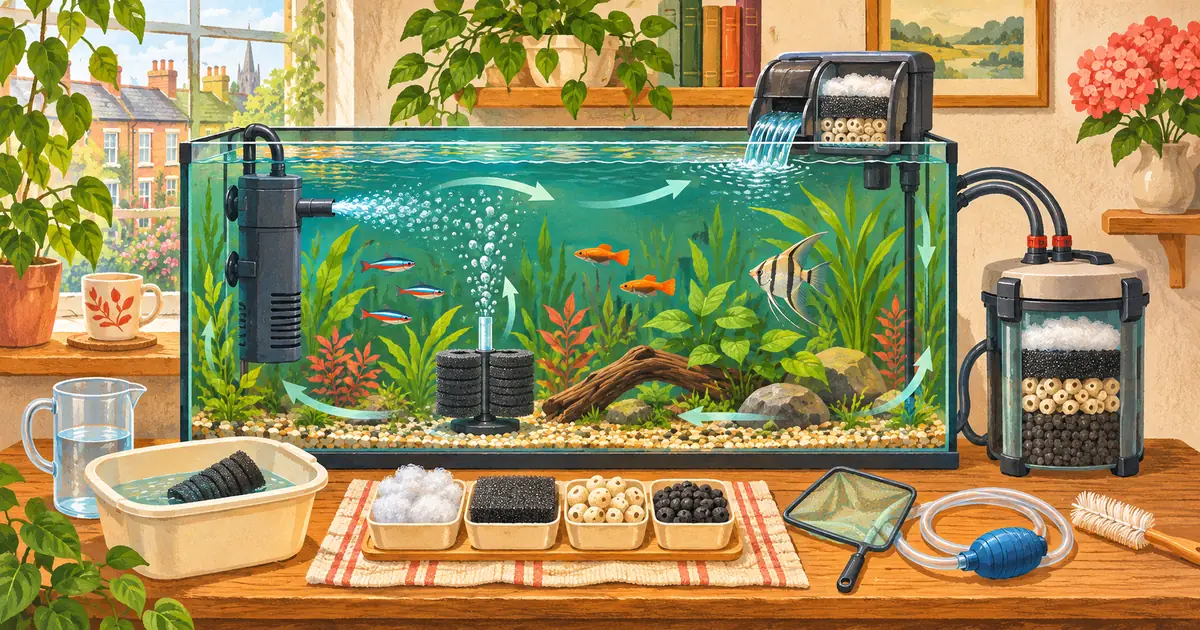
The best filter is the one that provides adequate biological and mechanical filtration for the aquarium, suits the fish’s preferred current and is easy enough to maintain consistently. A large quoted pump number cannot compensate for poor media care or unsuitable stocking.
We haven't tested these products. This comparison is based on makers' published specifications and manuals, retailer listings and owner reviews (checked 15 November 2026).
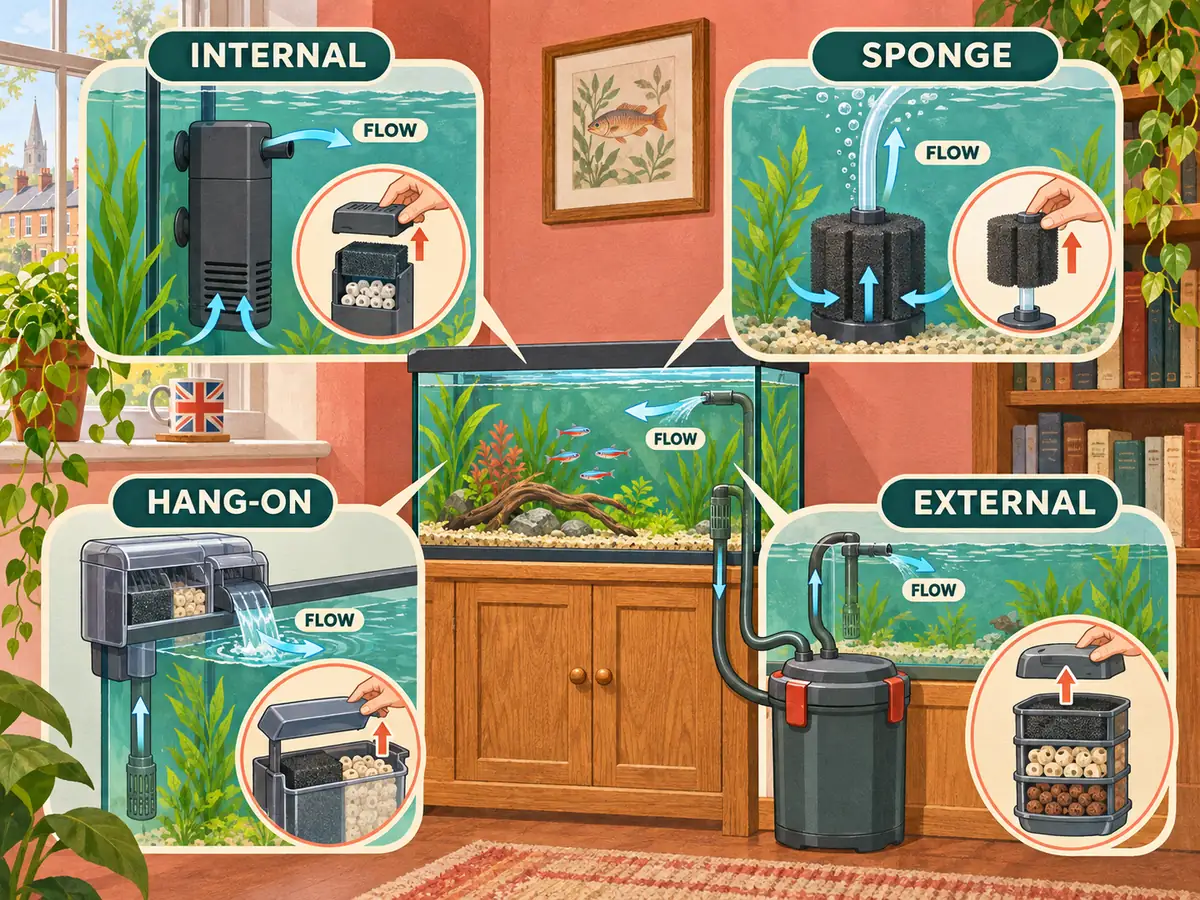
Four useful types
Examples of the filter formats discussed below are listed here for a current availability check: Fluval U1 internal filter, Fluval U2 internal filter, Fluval 207 external filter, allpondsolutions 1000EF external filter and Anxihanee sponge filter. See each product on Amazon UK, then confirm suitability against the maker's instructions and the aquarium's livestock plan.
Internal power filters sit inside the tank and are compact. Air-driven sponge filters offer gentle flow and a large bacterial surface, which can suit fry or quarantine tanks when correctly sized. Hang-on filters keep much of the body outside the aquarium but need a secure rim and suitable clearance. External canisters provide large media volume and keep hardware out of the display, though hoses and seals require careful installation.
Read two flow figures carefully
A maker may publish pump output and a lower filter-circulation figure. Fluval, for example, lists 550 litres per hour pump output and 360 litres per hour filter circulation for its 107 canister, with a published aquarium range of 40 to 130 litres. Media, hose height and dirt reduce real flow. Compare like with like and use the maker’s aquarium range as one input, not a stocking guarantee.
Media and maintenance
Mechanical foam catches debris; biological media provides surfaces for nitrifying bacteria; chemical media is used for specific purposes. Rinse reusable foam or biological media gently in removed aquarium water, not untreated tap water, and follow the manual. Stagger media maintenance so the biological filter is not stripped back in one session.
Match the fish, not just the litres
Long-finned fish and some small species may struggle in a harsh current, while active river species may need more movement and oxygenation. Protect intakes where fry or shrimp could be drawn in. Observe behaviour, keep the outlet agitating the surface appropriately and test water rather than assuming clear water is safe.
Compare filters on six questions
Start with the maker’s aquarium range, then ask how the figure was derived, whether output is pump or filter circulation, how much biological media fits, whether flow is adjustable, how the unit is serviced and what happens if it leaks. Noise matters only after installation conditions are matched: trapped air, a dirty impeller or a canister touching a cabinet can make a normally quiet design audible.
| Format | Strong point | Installation constraint | Best question to ask |
|---|---|---|---|
| Internal power | Contained water path and simple access | Uses tank space and can create a concentrated jet | Can flow be spread or reduced for these fish? |
| Air-driven sponge | Gentle current and intake safety | Needs an air pump, airline and non-return planning | Is there enough biological capacity for the load? |
| Hang-on-back | Media outside the display | Rim, lid and rear clearance must fit | Will it restart safely after a power cut? |
| External canister | Larger staged media volume | Hoses, valves, seals and cabinet height | Can the keeper lift and service it safely? |
Worked circulation comparison
For a nominal 100-litre aquarium, a published 500 litres per hour is five nominal tank volumes per hour: 500 ÷ 100. That is a comparison ratio, not proof of delivered flow or stocking capacity. Substrate and decor reduce actual water, while media, dirt and hose head reduce output. The Fluval 107 example on this page publishes 550 litres per hour pump output but 360 litres per hour filter circulation, illustrating why unlike figures must not be ranked in one table.
Outlet pattern also changes the experience. A narrow jet may buffet long-finned fish despite a moderate total; a spray bar can distribute movement but needs correct orientation. Watch whether fish can rest and feed normally, whether debris reaches the intake, and whether the surface moves enough for gas exchange.
Plan media by function
Coarse mechanical foam should catch larger debris before fine material blocks quickly. Biological media needs continuous oxygenated flow and gentle maintenance. Chemical media belongs to a stated purpose, such as removal specified by its maker, rather than being treated as permanent proof of filtration. OATA advises cleaning media in removed aquarium water and not changing all of it at once.
Before purchase, price any proprietary cartridges and check whether reusable media is permitted. Confirm that replacement seals, impellers and hoses remain available. A cheap unit that cannot be opened without destroying its bacterial media may cost more and destabilise the aquarium later.
Installation and failure checks
Prime and place the filter exactly as its manual states. Protect an intake used with fry or shrimp, without restricting it so severely that the pump starves. After every canister service, dry the outside and run a finger around valves and hose joints so a new drip is visible. Restore power after a simulated brief interruption and confirm that the unit restarts; never deliberately run it dry.
Filter-selection mistakes
- Ranking products by the largest litres-per-hour number without checking what it measures.
- Assuming a maker’s maximum tank size applies to heavily stocked or high-waste fish.
- Choosing an external unit that cannot be removed upright from the cabinet.
- Restricting an inlet instead of using the approved flow control.
- Replacing mature media to make the chamber look clean.
- Adding a second filter but failing to position outlets so water circulates through the whole tank.
The correct choice is the filter the keeper can maintain without exposing fish to interrupted circulation or lost bacteria. Confirm it with repeated zero ammonia and nitrite readings, not water clarity alone; the RSPCA identifies both tests as essential.