Guides · Equipment
Best aquarium heaters UK: sizing and safety
A UK guide to aquarium heater wattage, thermostats, guards, placement and independent temperature checks.
This page contains Amazon affiliate links. As an Amazon Associate we earn from qualifying purchases.
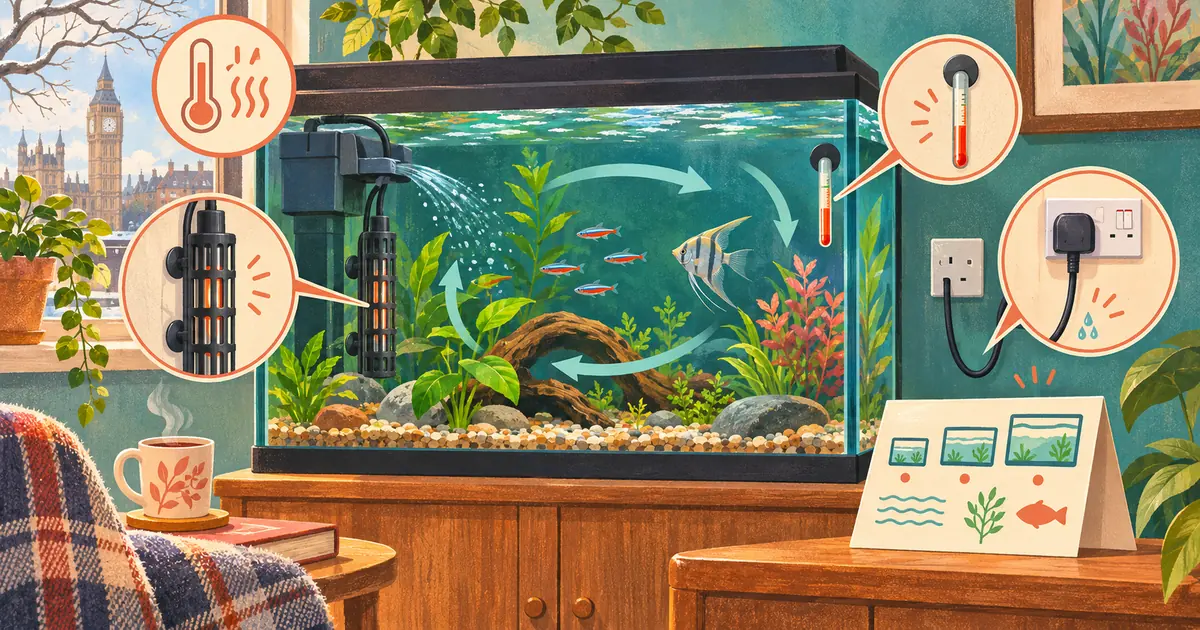
Choose a thermostatic aquarium heater for the required volume and the temperature difference between the room and the species target. The label on the heater is not a substitute for a separate thermometer and daily observation.
We haven't tested these products. This comparison is based on makers' published specifications and manuals, retailer listings and owner reviews (checked 15 November 2026).
A maker-published sizing ladder
Amazon UK listings relevant to the adjustable-heater comparison include the Fluval T100, Eheim Thermocontrol e100 and Eheim Thermocontrol e 300 W. The model name or wattage alone does not establish suitability: read the current listing and exact manual for tank volume, temperature difference and installation limits.
Fluval publishes its T-series as 50 W for up to 50 litres, 100 W for up to 100 litres, 150 W for up to 150 litres, 200 W for up to 200 litres and 300 W for up to 300 litres. That one-watt-per-litre pattern is useful only within the maker’s conditions. A cold room, open top or unusual target temperature can change the requirement, so follow the manual for the exact model.
Adjustable or preset
Preset heaters reduce controls but may target a temperature that is wrong for the chosen species. Adjustable units provide flexibility but still need monitoring. The RSPCA says tropical fish need the temperature appropriate to their species and that heaters should be thermostat-controlled. It also advises a digital thermometer and a daily temperature check because thermostats can fail.
Position and protection
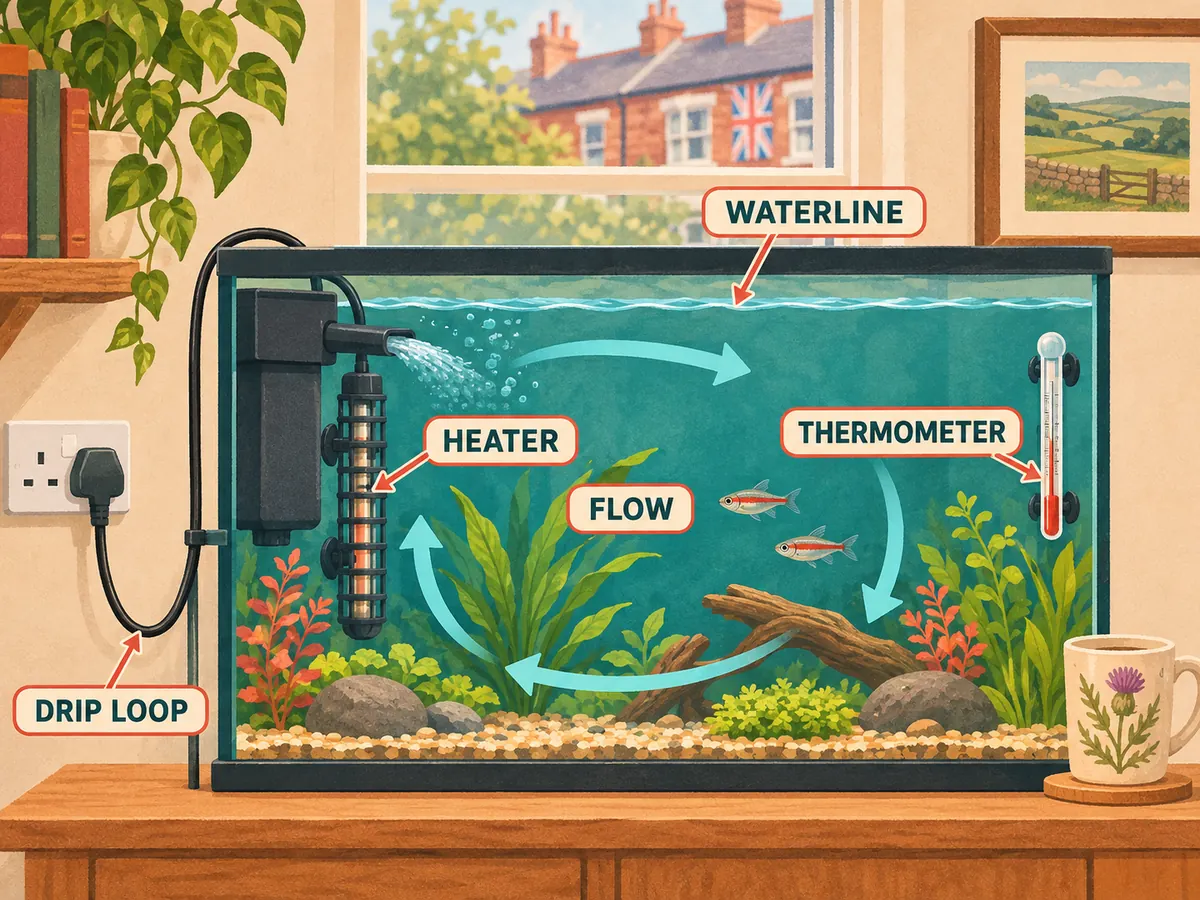
Put the heater where filtered water circulates past it, observing its minimum water line and orientation instructions. A guard can reduce direct contact and damage risk, but must be compatible. Unplug the heater and allow the manual’s cooling period before exposing it during a water change; never operate it dry.
Electricity near water
Keep plugs and connections away from splashes, use drip loops and never handle a plug with wet hands. Electrical Safety First warns that water and electricity are a dangerous mix and advises keeping aquariums away from electrical devices and cables. If socket protection or wiring is uncertain, ask a qualified electrician rather than improvising.
Size for the temperature gap
Tank litres are only the first input. Measure the coolest likely room temperature and subtract it from the species target. A tank held at 25°C in a room that falls to 16°C needs to bridge 9°C; the same tank in a 22°C room bridges 3°C. Lid coverage, airflow and aquarium shape also affect heat loss. Use the exact maker’s sizing chart for that gap, not a watt-per-litre saying detached from its conditions.
The gross label is not the operating water volume, but heater selection should still follow the manufacturer’s stated tank range. If a tank sits near a model boundary or the room is unusually cold, ask the maker or a competent aquatic retailer rather than automatically fitting an oversized unit that can heat water rapidly if its control fails.
Compare controls and safety features
| Feature | What it helps with | What it does not prove |
|---|---|---|
| Adjustable thermostat | Matching different species targets | Accuracy without a separate thermometer |
| Preset control | Fewer settings to alter accidentally | Suitability for every tropical fish |
| Heater guard | Reducing contact or impact risk | Compatibility with every heater or fish |
| Indicator light | Showing when the unit calls for heat | Correct water temperature |
| Over-temperature cut-out | Additional fault protection where specified | Permission to ignore daily checks |
Read the manual for immersion depth, orientation and clearance. Some heaters must be fully submerged; others show a minimum line. Place the unit in moving water, but not where fish are forced against it. A second thermometer belongs far enough away to represent the tank rather than the warm outlet plume.
Commissioning step by step
- Fit the unplugged heater with intact approved mounts and the correct clearance.
- Leave it immersed for the period stated by the manual before applying power.
- Set the species target and run the aquarium without fish while the temperature stabilises.
- Compare thermometer readings morning and evening and at the far end of a long tank.
- During water changes, unplug first and observe the stated cooling time before exposing glass.
- After refilling, confirm full immersion and wait the required period before reconnecting.
The RSPCA recommends thermostat-controlled heating for tropical fish, an independent digital thermometer and daily temperature checks because thermostats can fail.
What to do when temperature is wrong
If water is cool, confirm the socket, indicator, thermometer and flow before turning the dial. Check whether the room fell below the design assumption or the heater is coated or incorrectly positioned. If water is too warm, disconnect the suspect heater safely; do not add ice or make a sudden cold-water change. Increase surface movement where appropriate and seek competent advice for the species while temperature is brought back gradually.
A cracked tube, condensation where the design should be sealed, damaged lead or repeated overshoot means stop using the heater. Electrical Safety First advises keeping aquarium water away from plugs and cables and not handling electrical equipment with wet hands.
Heater mistakes to avoid
- Setting the dial from memory without checking the species’ actual range.
- Mounting behind dense decor where warmed water cannot circulate.
- Trusting an illuminated indicator instead of measuring temperature.
- Switching on while glass is partly exposed after a water change.
- Placing a thermometer directly beside the heater and missing a cold zone.
- Using one preset temperature for a quarantine tank that receives different species.
Record the model, wattage, setting, daily reading and room minimum. That small log distinguishes a cold-room sizing problem from a drifting thermostat and gives useful evidence before replacement.