Guides · Equipment
External vs internal aquarium filter
Compare canister and internal aquarium filters for media capacity, space, noise, leak risk, flow and maintenance.
This page contains Amazon affiliate links. As an Amazon Associate we earn from qualifying purchases.
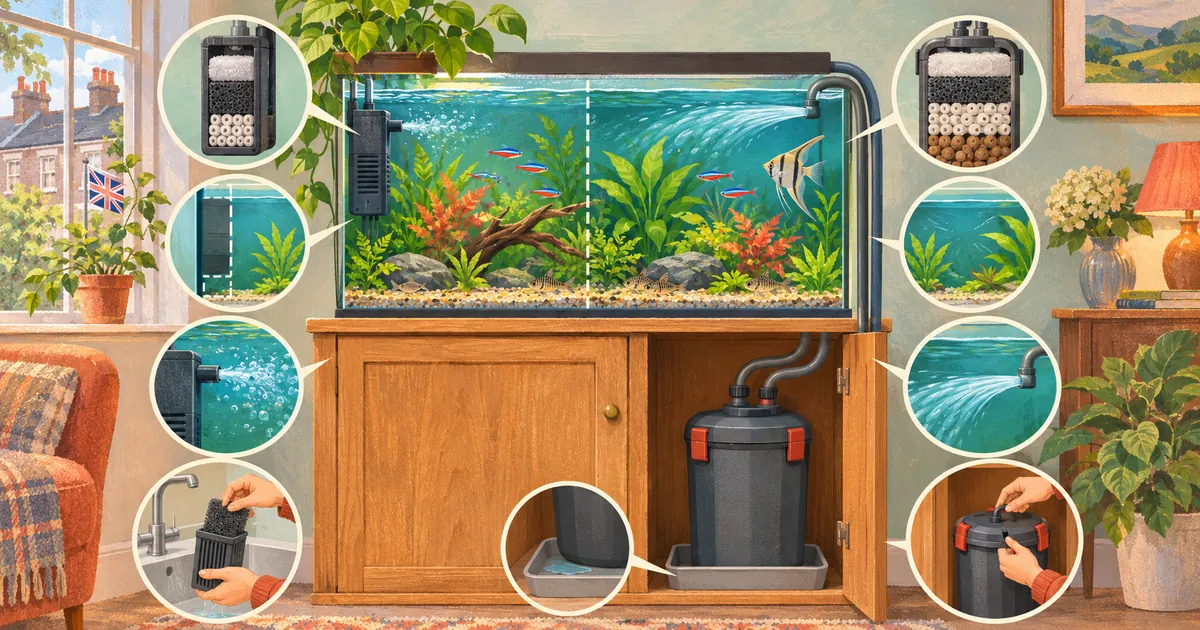
An internal filter keeps the water path inside the tank and is simple to inspect. An external canister can provide more media and a cleaner display but introduces hoses, seals and equipment below the waterline. Neither format is automatically better for every aquarium.
We haven't tested these products. This comparison is based on makers' published specifications and manuals, retailer listings and owner reviews (checked 15 November 2026).
Where internal filters win
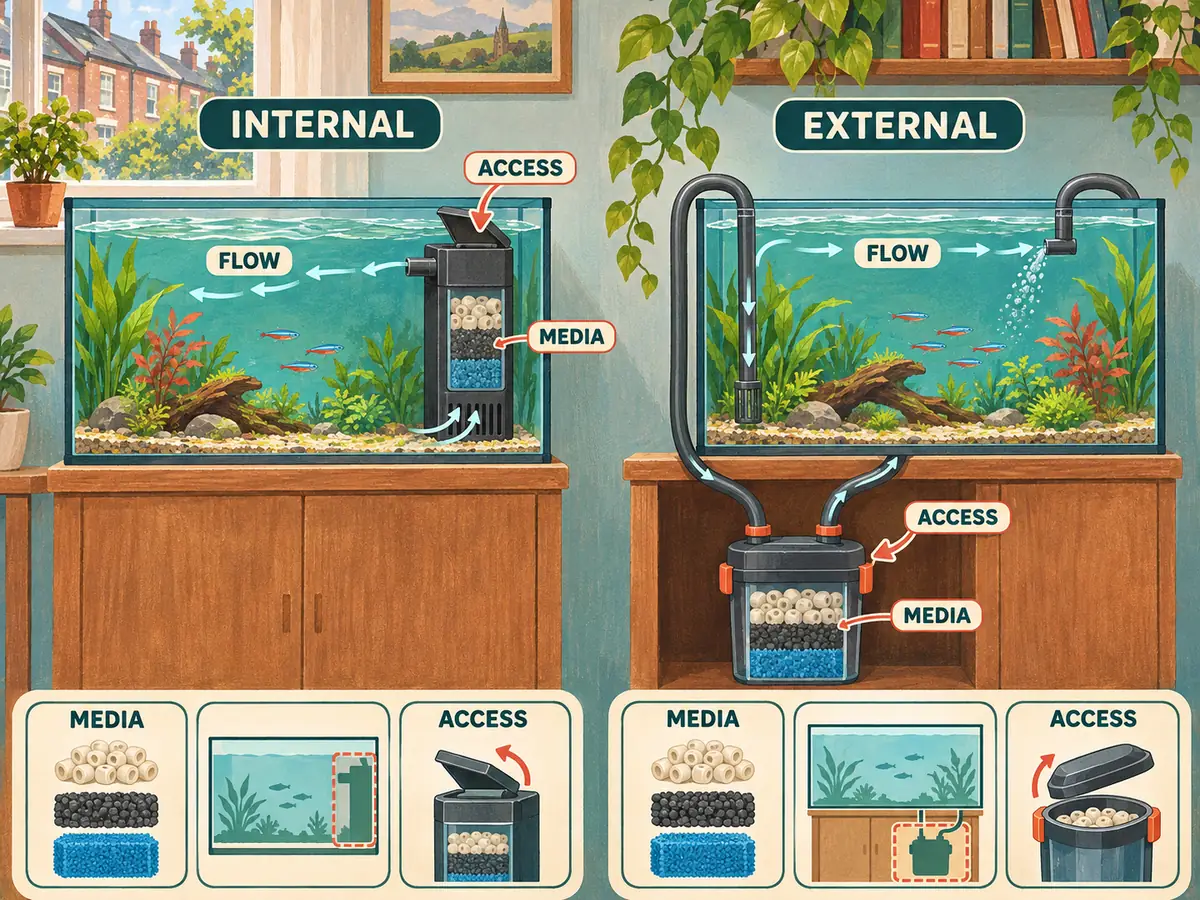
Internal filters are usually straightforward to fit, prime and remove. There are fewer external hose connections and a leak is more likely to remain within the aquarium. They do occupy swimming or planting space, and cleaning one can disturb the display. Small media chambers may need more frequent attention when the tank produces substantial debris.
Where external filters win
Canisters typically offer staged baskets and more room for mechanical and biological media. Intake and return positions can be adjusted, and visible equipment is reduced. The trade-offs are purchase cost, cupboard space, priming, hose cleaning and the need to inspect seals. Place the canister as its manual requires and test every connection after maintenance.
Published example
Fluval publishes the 107 canister for aquariums from 40 to 130 litres, with pump output of 550 litres per hour but filter circulation of 360 litres per hour. That difference is why a headline pump number should not be treated as delivered flow. Larger models increase published capacity, circulation, media volume and power draw.
Decision checklist
To compare the two formats in current listings, see the Fluval U2 internal filter, Fluval U4 internal filter, Fluval 207 external filter and allpondsolutions 1000EF external filter on Amazon UK. Treat the stated model range as a shortlist input, then check media, flow, installation clearance and the exact manual.
Choose after considering adult stocking, debris load, required current, available cabinet height, ability to lift a water-filled canister and willingness to maintain hoses. For either type, preserve biological media during cleaning, keep an intake guard where appropriate and confirm performance with water tests and fish behaviour.
Compare the ownership jobs
The meaningful difference is where water and maintenance travel. An internal unit is lifted through the aquarium and may release trapped debris into the tank. A canister is isolated, carried from the cabinet and opened elsewhere, but its hoses and seals hold water outside the glass. Choose the risk and routine the keeper can manage reliably.
| Decision point | Internal filter | External canister |
|---|---|---|
| Water path | Remains inside the aquarium | Travels through hoses below or beside it |
| Media room | Usually limited by in-tank size | Usually larger staged baskets |
| Service access | Wet hands over the display | Shut valves, disconnect and lift unit |
| Leak consequence | Usually contained by the tank | Connections require inspection after service |
| Display space | Occupies internal volume | Intake and return only are visible |
| Flow shaping | Outlet position may be constrained | Return hose or spray bar offers options |
Worked installation check
For a canister advertised at 40 cm high, do not accept a 41 cm cabinet opening as adequate. Add the height of valves and hose bends plus the clearance required to close taps and lift the motor head. Confirm the maker’s permitted position relative to water level. For an internal unit, draw its footprint on the tank plan and ensure the intake remains submerged through a routine water change.
Use circulation figures consistently. Fluval publishes 550 litres per hour pump output and 360 litres per hour filter circulation for the 107. Comparing the first number with another maker’s media-loaded circulation would exaggerate performance. Real delivery also falls as media loads and hose head increases.
Maintenance sequences
For an internal filter, unplug it, contain debris as it is lifted, clean the impeller and rinse reusable media gently in removed aquarium water. Refit securely, restore power and confirm flow. For a canister, follow the manual’s valve order, carry it upright, keep seals clean, reassemble baskets in the correct order, prime as specified and inspect every joint while running.
OATA advises preserving bacteria by cleaning media in aquarium water and not replacing everything together. The format does not change that biological requirement.
When each choice makes sense
An internal filter can suit a modest tank when its media capacity and controllable outlet match the planned stock, cabinet space is unavailable and simple servicing encourages regular care. A canister can suit a larger display or a plan needing more staged media and flexible returns, provided hose routing, leak checks and lifting are manageable. A sponge pre-filter or second filter may solve a specific intake or resilience problem, but extra equipment is not permission to overstock.
Format-specific mistakes
- Buying a canister that cannot be removed without kinking hoses.
- Closing a cabinet immediately after maintenance without checking for a slow drip.
- Pulling an internal filter out while running and spraying water towards electrics.
- Packing fine media so tightly that flow and oxygen delivery collapse.
- Assuming external automatically means quieter; trapped air and cabinet contact matter.
- Selecting internal solely because the nominal tank is small, despite high waste or unsuitable current.
Test ammonia and nitrite after major filter work and any interruption. The RSPCA warns that clear water can still be unsafe, so water chemistry and fish behaviour decide whether either format is succeeding.