Guides · Buying
Aquarium setup cost UK: a realistic first-year plan
Plan the upfront and ongoing cost of a freshwater aquarium in the UK without cutting the filter, testing or welfare essentials.
This page contains Amazon affiliate links. As an Amazon Associate we earn from qualifying purchases.
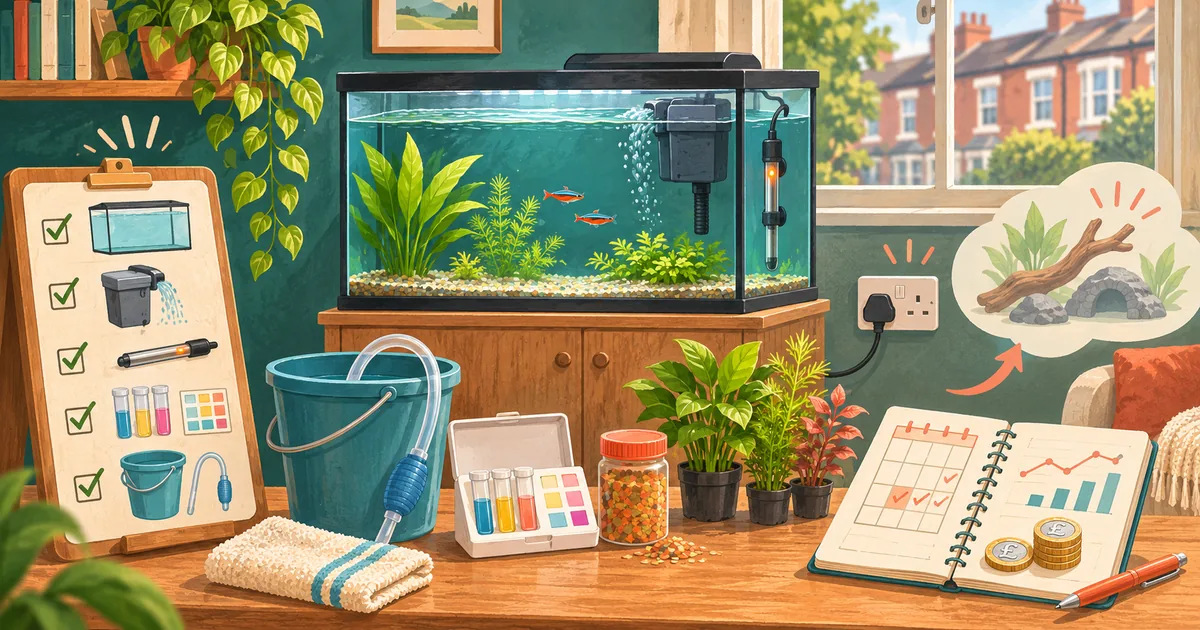
The tank is only one line in the budget. A safe stand, filter, heater where needed, testing, conditioner, maintenance tools, electricity, food and a contingency for replacement equipment all matter before livestock is considered.
We haven't tested these products. This comparison is based on makers' published specifications and manuals, retailer listings and owner reviews (checked 15 November 2026).
Dated retail examples
At Pets at Home, the Tetra Under the Sea 30-litre starter kit was listed at about £70, checked 15 November 2026. Charterhouse Aquatics listed Fluval Flex 2.0 kits at about £100 for 34 litres and £135 for 57 litres, while a 123-litre Flex aquarium was about £347, checked 15 November 2026. These examples show the spread, not a complete-market price range, and suitability must be decided by species needs rather than the cheapest box.
Essential first purchases
For a basket-building check rather than a price promise, Amazon UK currently lists a Juwel Primo 60 aquarium, Tetra cabinet for 54–80 litre starter tanks, Fluval T100 heater, API Freshwater Master Test Kit and enomol gravel siphon. Confirm dimensions, included equipment and compatibility before buying; a cabinet or heater must match the exact aquarium and intended livestock.
Allow separately for a suitable cabinet or stand, a heater if the kit lacks one, thermometer, ammonia and nitrite tests, nitrate and pH tests, conditioner, substrate if appropriate, plants or secure shelters, a siphon and dedicated bucket. The livestock budget belongs at the end, after the fishless cycle and water tests, not at the checkout with an uncycled tank.
Running costs
Electricity depends on equipment wattage, room temperature and how often a heater cycles. Consumables include conditioner, food and test reagents; some filters specify replacement cartridges. Do not replace useful biological media merely because a calendar says so unless the manual requires it. Keep a modest emergency allowance for a failed heater, pump or leaking hose.
Where not to save
Do not omit the filter, water conditioner, essential tests or a load-rated support. A bargain tank that is too small for adult fish creates a larger future cost and a welfare problem. Second-hand glass tanks can be economical only after careful inspection and a safe leak test in an appropriate place; electrical equipment needs its own condition check.
Build a zero-livestock budget first
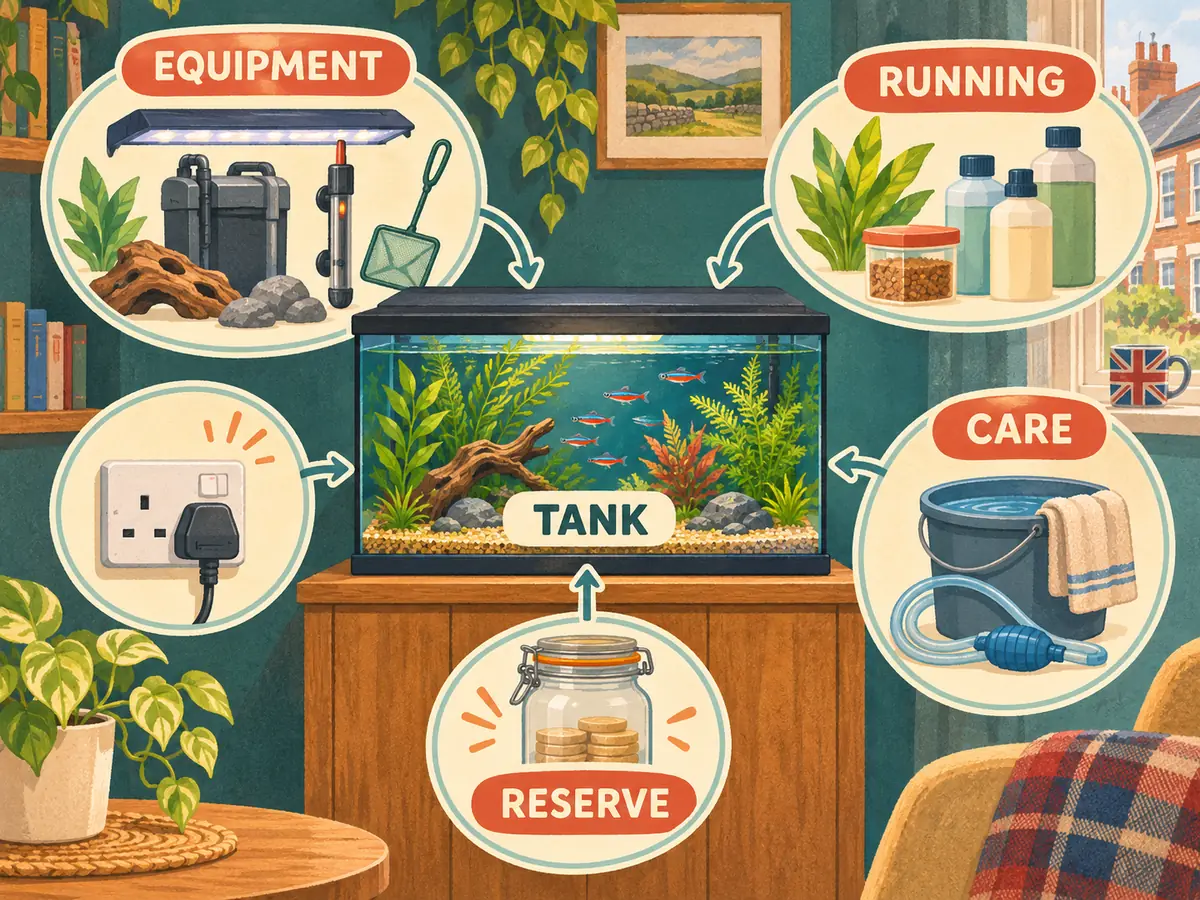
Separate the purchase into four pots: life-support equipment, setup consumables, ongoing supplies and contingency. The first pot includes the tank, correctly supported cabinet, filter, lid, light, heater where the species needs one, and thermometer. The second covers tests, conditioner, substrate, safe decor, siphon and aquarium-only bucket. Food, replacement reagents and electricity are ongoing; a failed heater, pump or leaking hose belongs in contingency.
Do not count a “complete” kit until its contents have been checked line by line. A heater channel is not a heater, a light is not necessarily suitable for demanding plants, and a cartridge filter may create continuing media costs. Tetra’s Starter Line page shows why the exact size matters: included equipment differs across the range.
Example worksheet without invented prices
| Item | Required before cycling? | Compatibility check | Cost evidence to record |
|---|---|---|---|
| Aquarium and cabinet | Yes | Exact footprint, total supported load | Retailer, model, date and delivered price |
| Filter | Yes | Maker tank range, media access, flow control | Included or separate; replacement media |
| Heater and thermometer | If livestock requires heat | Wattage, immersion rules, guard compatibility | Purchase price and rated watts |
| Water tests | Yes | Ammonia and nitrite included; expiry | Number of parameters and refill cost |
| Conditioner | Yes | Dose basis and disinfectants treated | Bottle size and cost per instructed dose |
| Plants and substrate | Before livestock | Species, grain, water chemistry | Quantity required for the footprint |
| Fish | Only after cycling | Adult needs and group size | Purchase last; exclude from setup total |
For a fair comparison, calculate the missing basket for each tank. Kit A may cost less at checkout but need a cabinet and heater; Kit B may include both yet use consumable cartridges. Record like-for-like totals rather than headline tank prices.
Estimate electricity transparently
A device’s maximum monthly energy is rated watts × 24 hours × days ÷ 1,000. A 10 W filter running continuously for 30 days would therefore have a maximum of 7.2 kWh. Multiply by the actual tariff shown on the household bill. A thermostatic heater does not normally draw its full rating continuously, so its real use depends on room temperature, lid, target temperature and cycling; measure it with suitable equipment rather than presenting the maximum as a forecast.
Never trade electrical safety for a lower running cost. Electrical Safety First warns about the combination of water and electricity. Damaged cables and unsuitable connections need replacement or qualified advice, not tape repairs.
Second-hand checks
Ask the seller for the exact model and age, inspect glass edges, silicone, brace bars and cabinet swelling, and leak-test the empty aquarium in a place where failure cannot damage property. A used tank can be economical; an unknown heater or cracked canister is false economy. Budget for new seals or media only when the maker still supports the model, and never assume an old cabinet fits because the litre number looks similar.
Cost mistakes that damage welfare
- Buying livestock with the tank and losing the time needed for fishless cycling.
- Spending on decorative effects before ammonia and nitrite tests.
- Omitting a proper stand, then improvising support under a filled aquarium.
- Replacing all biological media on a retailer schedule when the manual does not require it.
- Choosing the smallest tank to reduce purchase price despite adult species needs.
- Having no reserve for a failed filter or heater outside shop hours.
The RSPCA aquarium guidance recommends choosing fish only after researching their needs and favours larger, more stable aquariums. A responsible first-year total therefore includes unused capacity, testing and emergency cover rather than the maximum number of animals the remaining budget can buy.