Guides · Maintenance
Aquarium maintenance and water changes
A practical daily, weekly and monthly freshwater aquarium routine based on test results and safe partial water changes.
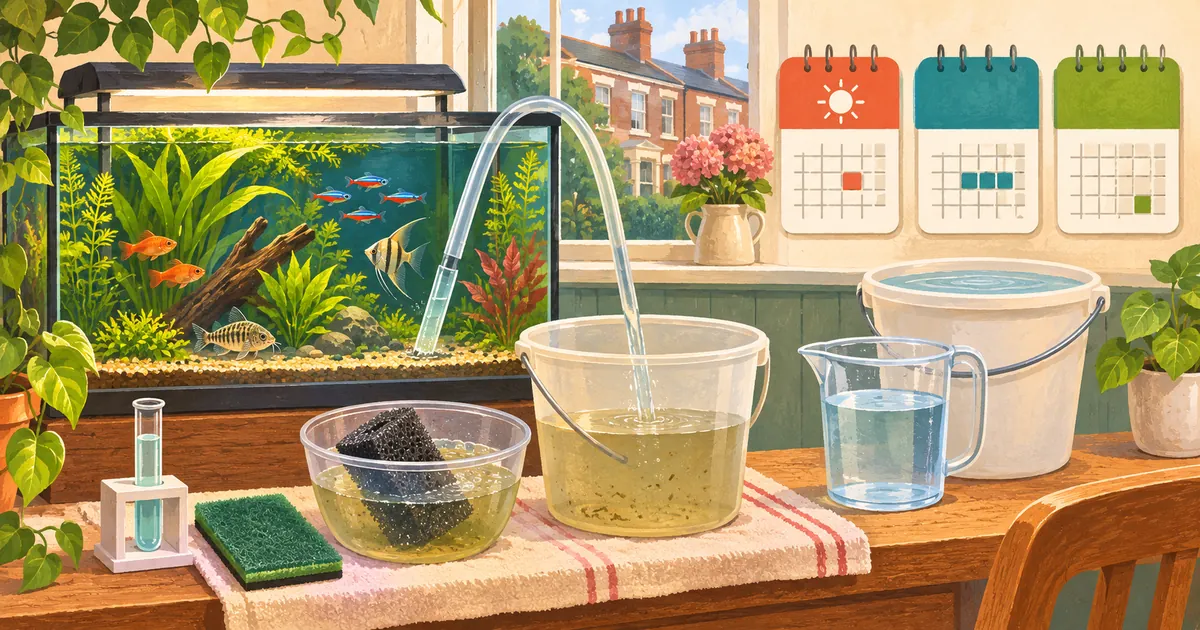
Maintenance keeps the environment stable; it should not repeatedly strip the aquarium back to sterile-looking parts. Test, remove accumulated waste, replace some water and preserve the filter bacteria.
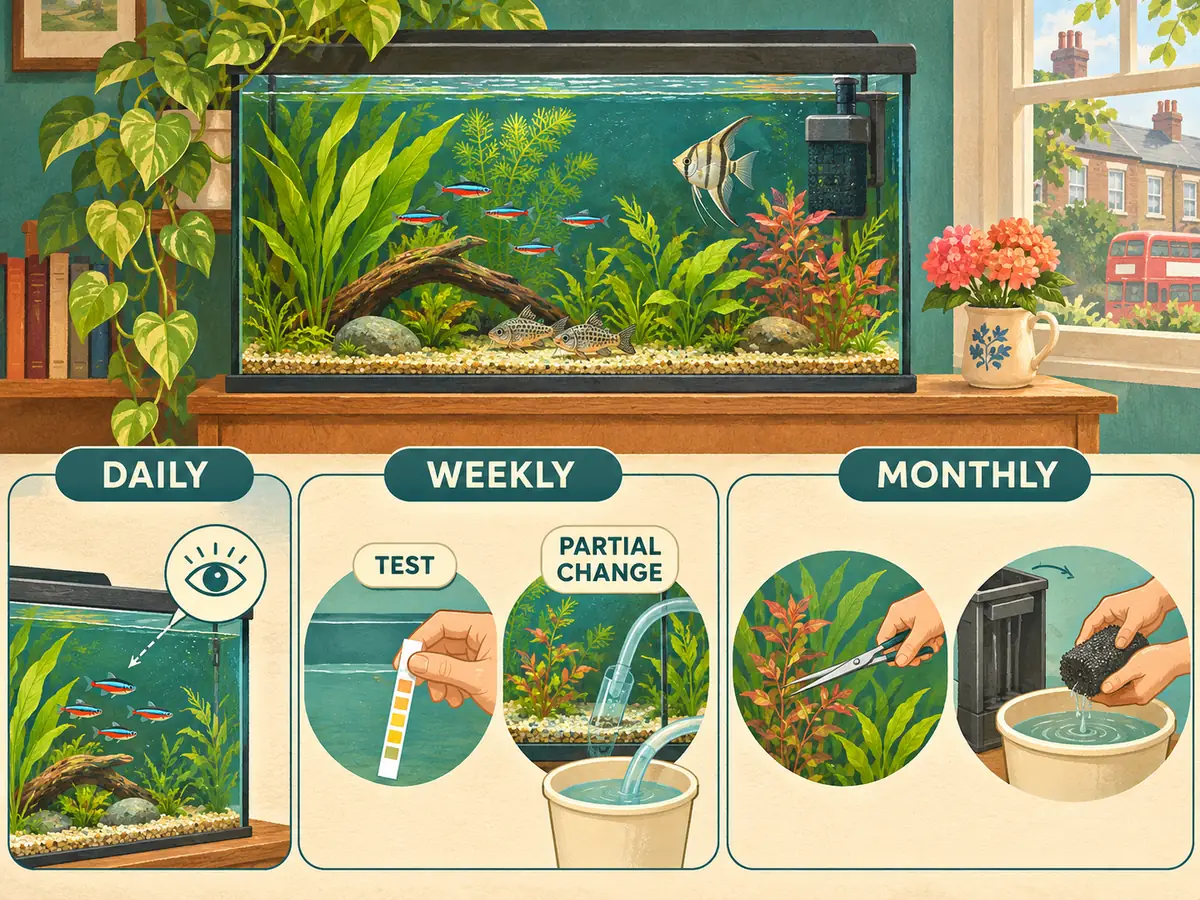
Daily
Observe every fish before feeding: breathing, swimming, appetite, fins, colour and interaction. Check temperature, flow, leaks and equipment noise. Remove uneaten food where practical. A sudden behaviour change is evidence to test water promptly, not a cue to add a random treatment.
Weekly pattern
Test the parameters relevant to the tank and perform a partial water change guided by results and stocking. The RSPCA describes weekly partial changes and stresses conditioned, temperature-matched replacement water. Siphon accessible debris without turning the entire substrate over in one session.
Filter care
When flow falls or the manual’s schedule requires it, unplug equipment, clean the impeller and rinse reusable media gently in removed aquarium water. Do not wash biological media under untreated tap water. Avoid replacing all media together. Restore equipment, check for leaks and verify flow before leaving.
Keep records
Log water results, change volume, filter work, livestock changes and consumables. A record shows whether nitrate is creeping upward or maintenance is becoming less effective. Keep a spare plan for power cuts and equipment failure, but never work on mains equipment with wet hands.
When a result is not zero
The RSPCA gives 0 mg/L as the safe level for both ammonia and nitrite. If tests show more than that, it advises changing half of the water every day and continuing to test until conditions improve, and asking an aquatics shop for help if the levels do not fall. Large emergency changes still need dechlorinated water at the same temperature as the tank; the RSPCA suggests a separate heater to warm replacement water. OATA notes that the right frequency and volume of routine changes depend on stocking and other factors, so a responsible retailer's advice for the specific tank is more useful than a fixed percentage copied from elsewhere.
A repeatable water-change method
Work out the replacement volume before lifting a bucket. For a tank holding about 72 litres of actual water, a 25% change is 18 litres. Mark an aquarium-only container at 18 litres so the amount is repeatable. Switch off equipment that must not run below its minimum water line, siphon the measured amount, then dose conditioner according to the product instructions for the volume it specifies. Match replacement temperature before adding water slowly. Restart the filter and heater, check that the intake has primed, and look for drips around hoses and plugs.
Do not deep-clean everything during the same visit. A sensible rotation is glass and an accessible patch of substrate this week, one filter pre-filter or foam when flow falls, and plant thinning on another day. This preserves bacterial surfaces and avoids stirring every trapped deposit at once. OATA’s freshwater care sheet says maintenance frequency varies with stocking and advises never replacing all filter media together.
Diagnose the result, not the appearance
| Observation | Check first | Targeted response |
|---|---|---|
| Flow has weakened | Intake, foam and impeller | Clean only the obstructed parts as the manual directs |
| Ammonia or nitrite detected | Repeat the test; check filter power and recent changes | Protect fish with conditioned, temperature-matched changes and get competent advice |
| Nitrate rises faster than usual | Feeding, missed changes, decaying material and stocking | Remove the cause and shorten the interval between partial changes |
| Cloudy water after substrate work | Tests, fish breathing and filter flow | Stop disturbing the bed; let mechanical filtration work if tests are safe |
| Heater exposed during draining | Power status and minimum-water mark | Leave it unplugged for the manual’s cooling and re-immersion periods |
A clear aquarium is not proof of safe chemistry. Conversely, harmless suspended dust should not trigger medication. Pair every visual observation with temperature and appropriate water tests.
Monthly and seasonal jobs
Inspect cable insulation, hose bends, clips, cabinet swelling and the tank seams. Wipe salt or mineral deposits before they obscure a leak. Check the thermometer against the heater setting, but do not assume matching numbers prove either device is accurate. In summer, watch for room-temperature rises and reduced dissolved oxygen; in winter, confirm that cold replacement water is warmed safely outside the aquarium. Electrical Safety First stresses that water and electricity are dangerous together: keep connections dry and stop using damaged equipment.
Replace test reagents and conditioner before expiry, not after an emergency. Keep enough conditioner for at least one substantial water change and know where a safe temporary container and battery air pump are stored. A power cut plan should prioritise oxygenation and stable temperature without opening or modifying mains equipment.
Mistakes specific to routine maintenance
- Topping up evaporation and calling it a water change; dissolved waste remains when water evaporates.
- Dosing conditioner by eye instead of using the maker’s cap or syringe scale.
- Siphoning so deeply around plant roots that the whole substrate is disrupted.
- Cleaning the impeller but forgetting the intake grille or kinked hose that caused low flow.
- Returning a bucket that has held detergent, paint or household cleaners to aquarium use.
- Feeding normally during an ammonia incident without considering the extra waste load.
Finish by recording the litres removed, results before and after intervention, and any equipment cleaned. The value of the log is diagnostic: if the same problem returns, it shows whether the interval, feeding or filter maintenance needs changing.