Guides · Planning
How to choose aquarium size, stand and position
Calculate gross volume and likely filled weight, then choose a level support away from heat, sun, sprays and electrical hazards.
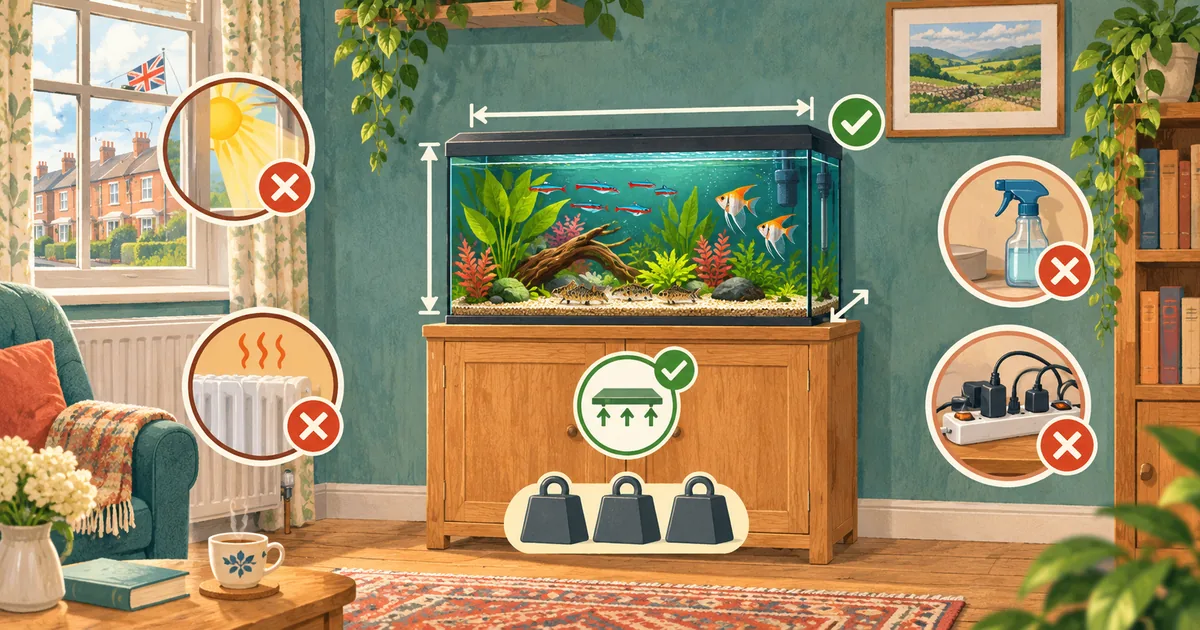
Choose the fish first on paper, then size the aquarium for their adult needs. A larger, well-supported tank is usually more stable than a tiny vessel, but water weight and floor loading need thought before filling.
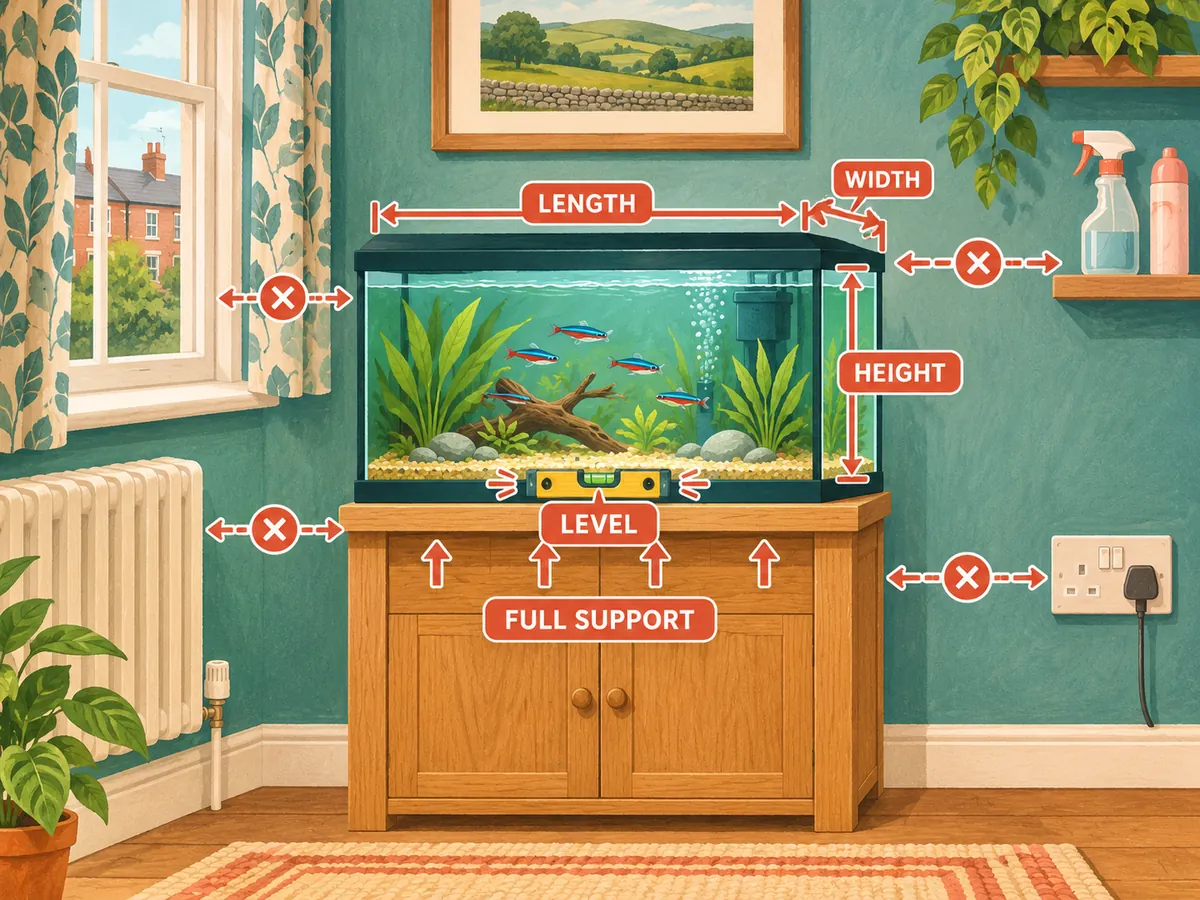
Volume and footprint
Rectangular gross volume in litres is length × width × water height in centimetres divided by 1,000. Substrate, rocks, an air gap and internal equipment reduce the actual water volume. Footprint matters because many fish use horizontal swimming length or territories; two tanks with the same litres can offer different habitats.
Weight
Fresh water is approximately one kilogram per litre for planning. Add the empty tank, cabinet, substrate, rocks and equipment. The total is concentrated over the stand’s footprint, so use a level, load-rated aquarium cabinet or support and follow the tank maker’s instructions about mats and full-base support. Seek competent structural advice if the floor is uncertain.
Room position
The RSPCA advises a sturdy surface away from radiators and direct window heat, and notes that aerosols and smoke can be harmful. Leave working room for the lid, filter, hoses and cables. Avoid a place where doors, play or regular traffic can strike the glass.
Water and electricity
Plan sockets so plugs and adaptors cannot be splashed and cords can form drip loops. Do not place a multiway extension on the floor below hoses. Electrical Safety First advises keeping the aquarium away from electrical devices and cables. If the fixed installation needs change, use a qualified electrician.
Minimum size and shape
The RSPCA says bigger is better and advises only buying a tank larger than 45 × 30 × 30 cm (about 40 litres), because larger volumes keep temperature and water conditions more stable. Its worked example is a 60 × 30 × 30 cm tank holding 54 litres. It also prefers wide tanks to tall ones: oxygen enters at the surface, so more surface area per litre helps. Some fish sold when small grow far too large for home aquariums, and the RSPCA names red tail and shovelnose catfish, pangasius, giant gourami and pacu as examples. OATA likewise advises buying as big as reasonably possible for the fully grown fish and keeping the tank away from loud noise, vibration and sudden movement.
Work from inside out
Begin with adult species requirements: horizontal swimming length, social group, territory, temperature and water chemistry. Convert that plan into a minimum internal habitat, then consider the tank’s external dimensions, lid clearance, filter hoses and working space. The advertised litres are never the whole decision.
| Location check | Measure or inspect | Reason to reject the spot |
|---|---|---|
| Support | Full footprint, level and cabinet rating | Overhang, twist or unknown furniture strength |
| Floor | Joist direction and structural uncertainty | Bounce, visible weakness or no competent answer |
| Light and heat | Direct sun, radiator and seasonal room range | Rapid heat gain or temperature swings |
| Access | Lid opening, buckets, canister removal | Routine work cannot be done safely |
| Services | Dry socket route and drip loops | Adaptors lie below possible leaks |
| Disturbance | Doors, speakers, foot traffic and vibration | Repeated impact or startle risk |
Worked volume and load example
A rectangular water column 80 cm long, 35 cm wide and 35 cm high has a gross geometric volume of 98 litres: 80 × 35 × 35 ÷ 1,000. Actual water will be lower after the air gap, substrate, rocks and internal equipment. For a conservative placement check, do not subtract those litres and stop: add the empty aquarium, cabinet, substrate, stone and equipment to roughly 98 kg of water.
That total load is distributed through the cabinet footprint only when the cabinet is intact, level and used as the aquarium maker specifies. A mat is not universally required; some tanks require one and some framed bases do not. Follow the exact manual. Seek competent structural advice for suspended floors or uncertain construction rather than relying on a generic online load claim.
Dry-run the maintenance route
Put the empty cabinet in position and open every door and lid. Lift the filter basket or canister through its intended path. Carry an empty change bucket from the sink, checking thresholds and cable trip points. Verify that a siphon can reach and that spills can be dried without water running into a socket. Leave room to inspect rear seams and hose joints.
The Electrical Safety First guidance highlights the danger of mixing water and electricity. Use drip loops, keep connections dry and ask a qualified electrician if fixed wiring or socket protection is uncertain.
Position mistakes that appear later
- Measuring the glass but not the lid when open.
- Placing a canister in a cabinet too short to close its valves or remove the head.
- Filling beside a sunny window and discovering summer overheating.
- Supporting only the tank corners when the manual requires full-base support.
- Leaving no route for a full aquarium to be drained during a leak.
- Choosing a narrow tall tank for fish that need length and surface area.
Welfare and legal context
The Animal Welfare Act 2006 requires reasonable steps in England and Wales to meet an animal’s needs, including a suitable environment; Scotland and Northern Ireland have separate legislation. Position is therefore a welfare choice, not interior styling. The RSPCA advises sturdy support away from radiators and direct window heat, while OATA adds loud noise, vibration and sudden movement to the list of concerns.
Make the final decision while the tank is empty. Once filled, never try to slide it into a better position: drain and dismantle according to the maker’s instructions.