Guides · Livestock
Goldfish tank setup: space, filtration and care
Why bowls are unsuitable, how to plan around adult goldfish, and what filtration, oxygen and maintenance must provide.
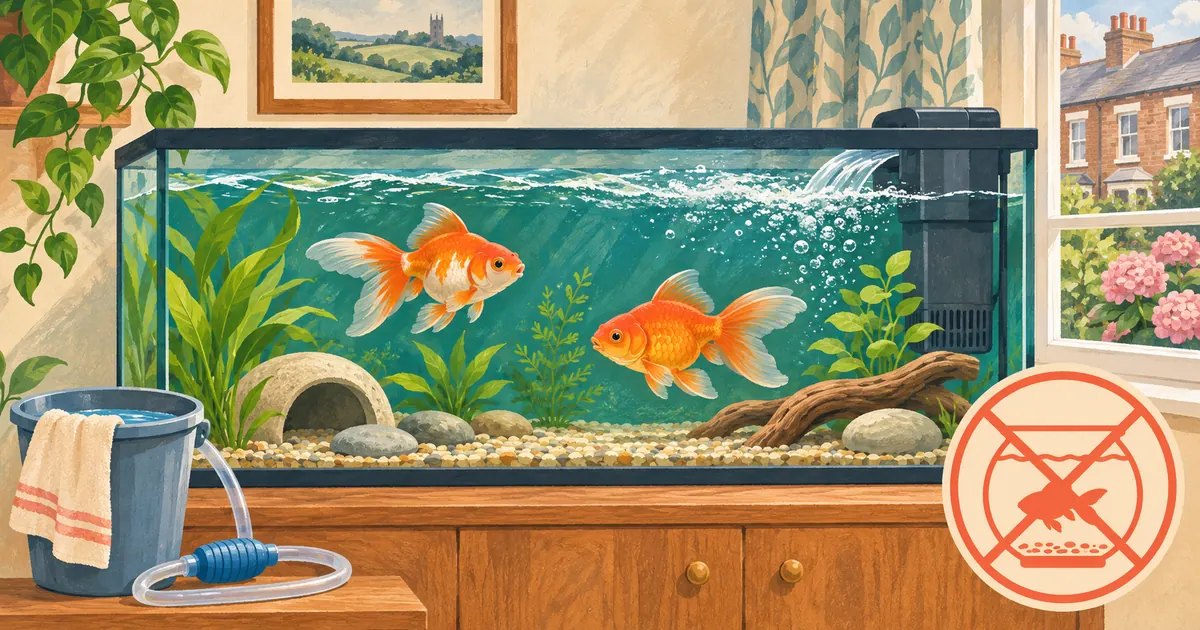
Goldfish are not small disposable decorations. They grow, produce substantial waste and need stable, filtered, oxygenated water with swimming space. Plan for the adult fish before bringing one home.
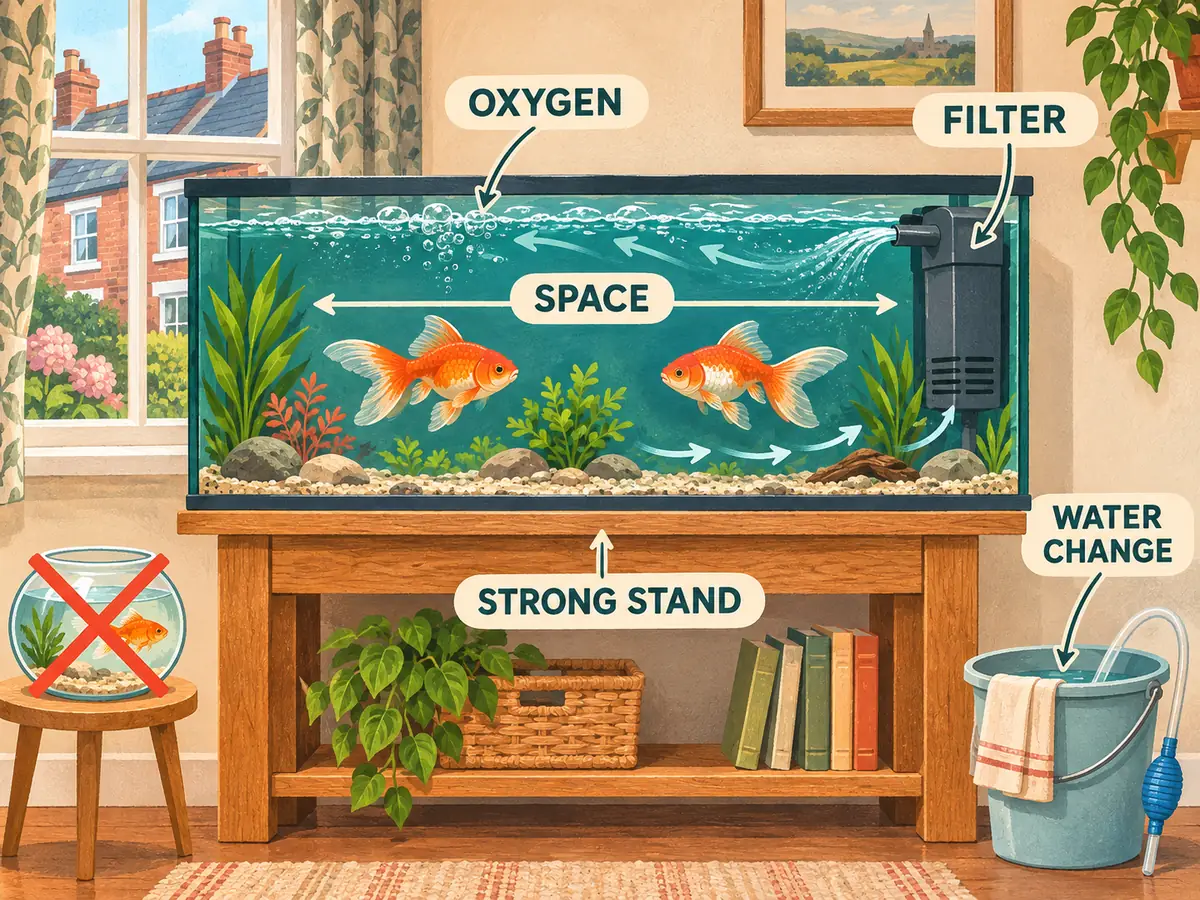
No bowls
The RSPCA says decorative bowls and jars are not designed with fish welfare in mind: they are too small, offer poor space for filtration, have little surface area for oxygen exchange and change temperature rapidly. Its aquarium guidance states at least 60 litres of water per goldfish as a starting point, with larger systems needed as fish grow and for groups.
Tank shape and filter
Prioritise horizontal swimming length and surface area. Use a filter capable of handling the waste while avoiding a current that prevents normal swimming. Cycle it without fish, then confirm zero ammonia and nitrite. Strong filtration does not cancel the need for adequate water volume or partial changes.
Temperature and companions
The RSPCA gives 10–21°C for goldfish and says a heater is not normally needed, though stability matters. Fancy and single-tailed varieties differ in speed and body shape and may not compete fairly for food. Check adult size and compatibility; many common single-tailed goldfish ultimately suit a properly designed pond better than a typical indoor tank.
Ongoing welfare
Use an appropriate varied diet, watch body condition and remove uneaten food. Test ammonia, nitrite and nitrate, keep the filter working and change conditioned water as results require. The Animal Welfare Act duty in England and Wales includes a suitable environment, diet, normal behaviour and protection from suffering.
Heaters, thermometers and ponds
If you are worried about temperature swings, the RSPCA suggests a goldfish tank heater can be set at the lower limit of the 10–21°C range. Any heater must be thermostat-controlled, and because heaters and thermostats can fail, the RSPCA advises using a digital thermometer and checking the temperature every day. Do not place the tank by a window, which can push the water temperature dangerously high. Its rough space guideline for goldfish is 2 litres of water per 0.5 cm of fish length, alongside the 60-litre minimum per fish. If a goldfish outgrows its tank, rehome it responsibly rather than releasing it: the RSPCA does not recommend releasing fish into outdoor ponds, because they can harm wildlife and spread disease.
Plan for the actual goldfish
“Goldfish” covers body forms with different swimming ability and adult potential. Identify whether the fish is a fancy variety or a faster single-tailed type, research its adult size and decide whether the planned group can compete fairly for food. Do not mix animals merely because they share a shop label. The tank must allow normal turning and sustained horizontal swimming after decor is installed.
| Design choice | Goldfish-specific reason | Practical check |
|---|---|---|
| Broad rectangular tank | Swimming length and surface exchange | Measure usable length, not only litres |
| Substantial maintainable filter | Goldfish produce considerable waste | Media remains mature during cleaning |
| Secure smooth decor | Fish forage and can dislodge objects | No sharp gaps or unstable stacks |
| Open feeding area | Lets the keeper observe each fish | All individuals reach food without collision |
| Tight-fitting safe cover | Reduces escape risk while allowing equipment | Cables and returns do not create gaps |
Use volume guidance cautiously
The RSPCA gives at least 60 litres per goldfish and a rough 2 litres per 0.5 cm of body length excluding the tail. These are starting guides, not a way to justify crowding. A large adult single-tail can require a much larger environment than multiplying its juvenile shop length, and social group, footprint, filtration and maintenance still matter.
For two fish, do not simply buy 120 nominal litres and stop planning. Substrate and decor reduce water; the filter occupies space; the shape may be too short; and compatibility may be poor. Use the adult plan to choose the tank, then keep spare capacity for growth and stable chemistry.
Feeding and waste control
Offer an appropriate varied goldfish diet in portions that can be monitored, removing uneaten food. Watch whether a slower fancy is outcompeted. Weighing food is more repeatable than pinches when troubleshooting, but follow the food maker and veterinary advice rather than inventing a universal ration. Test ammonia and nitrite after any feeding increase, new fish or filter interruption.
Partial water changes dilute accumulated nitrate and other dissolved waste, while siphoning removes accessible solids. They do not replace adequate tank size. Rinse reusable media in removed aquarium water and stagger cleaning so biological filtration is preserved.
Temperature and oxygen incidents
Goldfish are not a reason to ignore temperature. The RSPCA publishes 10–21°C and recommends daily thermometer checks; sudden change is the concern. During hot weather, keep the tank out of sun, check surface movement and seek competent advice if fish gasp. Do not cool rapidly with ice. If a heater is used for stability at the lower end, it must be thermostat-controlled and installed to its manual.
Goldfish setup mistakes
- Choosing a bowl because the fish is small on purchase day.
- Treating strong filtration as a substitute for swimming volume.
- Mixing quick single-tails with slower fancy varieties without checking feeding competition.
- Using small gravel that a foraging fish can take into its mouth.
- Releasing an unwanted fish into a pond or waterway, risking wildlife and disease spread.
- Waiting for cloudy or smelly water before testing ammonia and nitrite.
When the plan no longer fits
Measure and photograph growth, reassess turning room and observe feeding. Arrange responsible rehoming before the fish becomes cramped; never release it. The legal duty in England and Wales under the Animal Welfare Act 2006 includes a suitable environment, suitable diet, normal behaviour, appropriate company and protection from suffering. Planning for an adult goldfish is therefore part of setup, not a later upgrade option.