Guides · Livestock
Stocking a freshwater aquarium responsibly
Plan stocking by adult size, behaviour, shoal needs, water chemistry, swimming space and filter maturity—not inches per gallon.
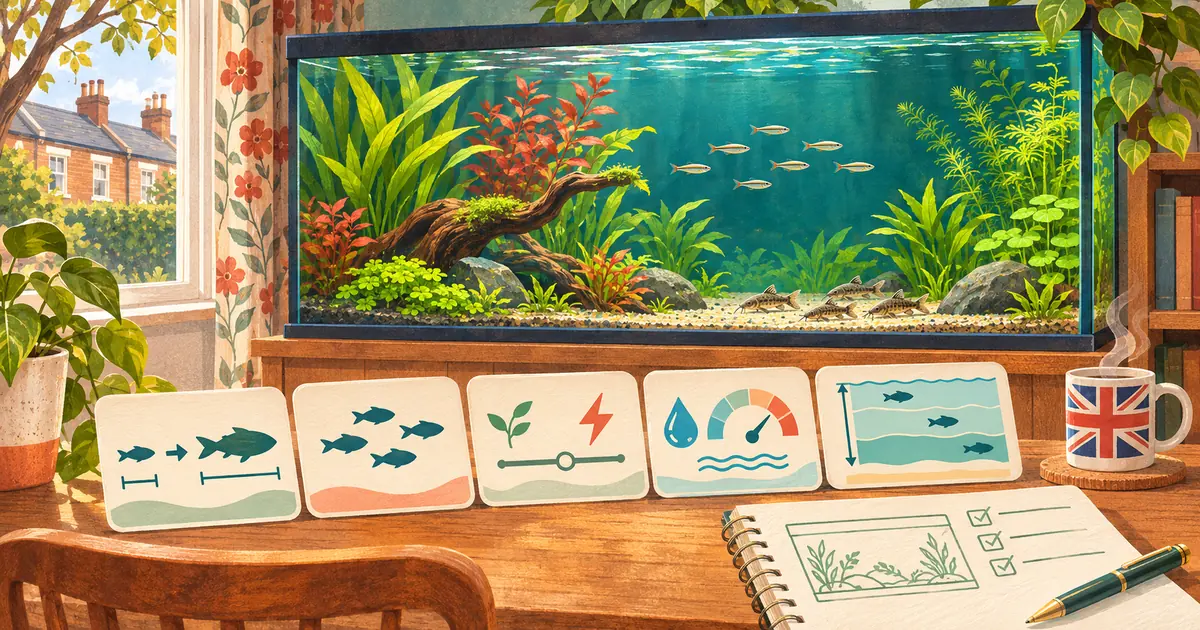
No single centimetres-per-litre rule can account for body shape, activity, territory, waste, oxygen demand and social behaviour. Make a species list before purchase and check every choice at adult size.
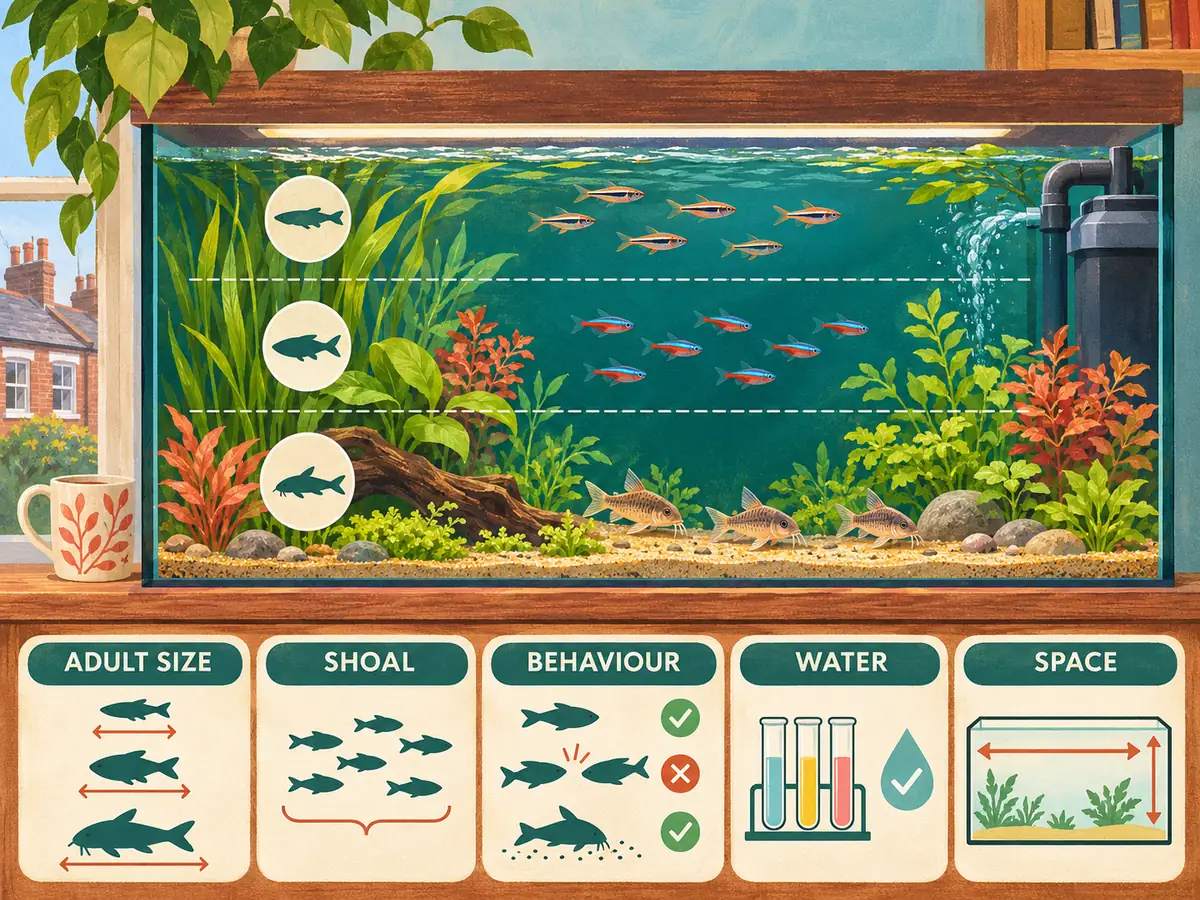
Why simple rules fail
OATA says it is not possible to state exactly how many fish an aquarium can hold because body size, species requirements, water parameters and compatibility vary. The RSPCA publishes rough volume guidance but explicitly says it is only a guideline affected by temperature, water source, filtration and care.
Build the plan
For each species record adult length and body mass, preferred temperature, pH and hardness range, group size, activity level, territory, diet and likely tank zone. Check whether it is a shoaling species, a pair-former, solitary or aggressive. Do not use juvenile shop size as the final requirement.
Add slowly
Complete the fishless cycle, add only a modest compatible first group and test closely. OATA explains that bacterial populations need to expand after more fish or feeding are added. A visually empty tank during this period is not a problem; rushing can expose animals to ammonia and nitrite.
The welfare duty
Section 9 of the Animal Welfare Act 2006 applies in England and Wales and includes needs for a suitable environment, diet, normal behaviour, appropriate company or separation, and protection from suffering, injury and disease. Scotland and Northern Ireland have their own legislation; the practical duty to research the animal remains.
Rough guidance and beginner species
The RSPCA suggests allowing 1.5–2 litres of water per 1 cm of tropical fish length (excluding the tail), and 2 litres per 0.5 cm of goldfish length. It presents both figures only as guidelines. It also warns that some fish grow far too large to be suitable pets, naming red tail and shovelnose catfish, pangasius, giant gourami and pacu. OATA recommends hardy species that can live together when you are starting out. It lists tetras, guppies, mollies, platies, swordtails, corydoras and gouramis as good beginner tropical choices. Its broad groups still contain species with very different needs: some must be kept in shoals, while others are territorial or aggressive. Check each species' care sheet before adding it to the plan.
Build a compatibility matrix
Write one row per species before visiting a shop. Use scientific names because common names can cover different fish. Fill in adult size and body shape, minimum social group, tank zone, swimming pattern, territory, temperature, pH, GH, diet and known risks such as fin-nipping or predation.
| Conflict to test | Example question | What resolves it |
|---|---|---|
| Temperature | Do all species share an overlapping long-term range? | Choose a different combination, not a compromise outside both ranges |
| Hardness | Does local GH suit every proposed fish? | Prefer species suited to the source water |
| Space | Do bottom territories overlap? | Increase footprint or remove a species |
| Social needs | Is the group large enough for normal behaviour? | Budget tank space for the full group |
| Feeding | Will shy or slow fish receive suitable food? | Separate plan or compatible tankmates |
| Adult size | Could any fish swallow another later? | Judge adults, not shop juveniles |
Worked planning example
Imagine a 90-litre label and two proposed shoaling species. A simple length-per-litre calculation may appear to leave room, yet both groups might use the same middle-water zone and require six or more individuals. Adding a territorial bottom fish could then remove retreat space even though the arithmetic “fits”. The correct response is to reduce the number of species, not shrink each social group below its needs.
Now check the actual water volume after decor, the horizontal length, local GH and the adults’ activity. If one species needs soft water and another hard water, filtration capacity cannot solve the conflict. This is why OATA says no exact universal fish number can be stated.
Add stock in stages
After fishless cycling, introduce the first compatible group and record ammonia and nitrite daily at first or as competent advice directs. Feed modestly, observe respiration and allow the bacterial population to respond. Add nothing else while either compound is detectable. A later zero result does not compel another purchase; unused capacity improves resilience.
Quarantine new fish where practical. When they enter the display, repeat enhanced testing because the established filter must adapt to more waste. Do not replace or deep-clean media during the same period.
Use rough rules only as warning screens
The RSPCA publishes 1.5–2 litres per centimetre of tropical-fish body length, excluding the tail, and explicitly calls it a guideline affected by other factors. It can flag an obviously crowded draft but cannot approve cichlid territories, a shoal’s swimming length or a high-bodied fish using a narrow tank. Goldfish have separate guidance and should not be inserted into the tropical calculation.
Stocking mistakes
- Counting juvenile centimetres rather than researched adult size.
- Adding one specimen each of several social species to create variety.
- Treating algae eaters as equipment without checking their diet and adult needs.
- Assuming fish in different vertical zones never interact or compete for oxygen.
- Filling all theoretical capacity immediately after cycling.
- Buying a “clean-up crew” to solve overfeeding or poor maintenance.
Know when to stop
Stop adding animals when social groups are complete and the aquarium is stable, not when every visible area contains fish. Watch feeding access, hiding, aggression, breathing and night-time behaviour as well as tests. Section 9 of the Animal Welfare Act 2006 includes normal behaviour and appropriate company or separation within the keeper’s duty in England and Wales; other UK nations have separate legislation. A lightly stocked aquarium that meets group needs is a successful plan, not an unfinished one.